

Most people should get a dental cleaning every six months. But the real answer is not the same for everyone. Your ideal schedule depends on your gum health, cavity risk, tartar buildup, age, medical history, and daily habits.
So, how often should you get dental cleanings? For many healthy adults, twice a year is a good starting point. Some people need cleanings every three to four months. Some low-risk adults may be able to go longer, but only after a dentist confirms it is safe.
This guide explains how to find your real dental cleaning frequency without fear or guesswork.
This article is for education only. It is not a diagnosis.
Table of Contents
ToggleIs Twice a Year Enough for Teeth Cleaning?
For most people, a dental cleaning every six months is a good starting point. It helps remove tartar, check for cavities, monitor gum health, and catch problems early. However, six months is not a rule for everyone. The ADA supports a more personalized approach based on your oral health, risk factors, and dental needs.
The CDC recommends that adults visit a dentist at least once a year, even if they have dentures or no natural teeth. This is a minimum baseline, not a schedule that works for every person.
You may need cleanings more often if you have gum disease, diabetes, pregnancy, smoking habits, dry mouth, braces, heavy tartar buildup, or a weakened immune system. Your dentist can help determine the right schedule for your needs.
What Actually Happens During a Dental Cleaning?
A dental cleaning removes plaque and tartar that regular brushing and flossing cannot fully remove.
During a cleaning, your dental team usually:
- Checks your teeth and gums for cavities, gum problems, and other concerns. X-rays may be taken when needed.
- Removes plaque and tartar with professional tools. Plaque can harden into tartar within about 24 hours, and only a dental professional can remove hardened tartar.
- Polishes your teeth to remove surface stains and smooth the tooth surface.
- Cleans between your teeth with flossing to remove leftover buildup.
Regular cleanings help find problems early, but they do not replace daily brushing and flossing at home.
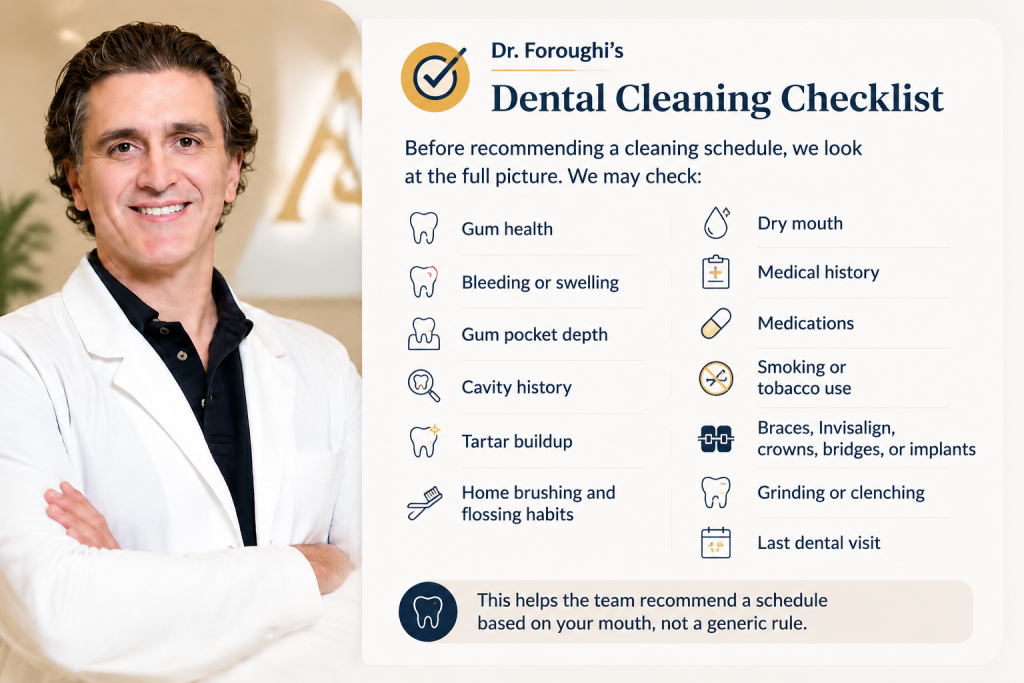
The 3 Types of Cleanings and How Often Each is Needed
| Cleaning Type | What It Means | Common Schedule |
| Routine cleaning | A standard cleaning for people with healthy gums | Often every six months |
| Gross debridement | A catch-up cleaning when there is heavy buildup after a long gap | Used as needed before a full exam or routine cleaning |
| Deep cleaning | Scaling and root planing for diagnosed gum disease | Done when needed, then followed by maintenance |
- For a routine cleaning, a gross debridement may be needed if there is so much tartar that the dentist cannot clearly examine the teeth and gums.
- Cleveland Clinic describes scaling and deep cleaning as a treatment for gum disease, not a normal cleaning for every patient.
- After deep cleaning, many patients need periodontal maintenance (ongoing cleaning after gum disease treatment) every three to four months.
Who Should Get Cleanings More Than Twice a Year?
Some people need dental cleanings more often than every six months because they have a higher risk of plaque buildup, tartar, gum disease, or cavities.
You may need cleanings every 3 to 4 months if you have:
- A history of gum disease
- Bleeding or swollen gums
- Diabetes
- Pregnancy-related gum changes
- Smoking or tobacco use
- A weakened immune system
- Heavy tartar buildup
- Braces or Invisalign
- Chronic dry mouth
- Deep gum pockets
- Fast plaque buildup
- Frequent cavities
Dry mouth can increase the risk of plaque and cavities because saliva helps protect your teeth. People with a history of gum disease may also need periodontal maintenance instead of regular cleanings.
If your gums bleed, swell, or pull away from your teeth, your dentist may recommend gum treatment and a shorter cleaning schedule. A custom night guard may also help protect your teeth if grinding causes wear or jaw discomfort.
Who Can Sometimes Go Longer Between Cleanings?
Some low-risk adults may be able to go longer than six months between cleanings, but a dentist should confirm the right schedule first.
You may be at lower risk if you have:
- Healthy gums
- No recent cavities
- Little tartar buildup
- Good brushing and flossing habits
- No history of gum disease
- No major dry mouth
- No smoking habit
- No braces or aligners
- Regular dental exams
Even if your teeth feel healthy, cavities and gum disease can develop without pain. Your dentist can check your gums, tartar buildup, and overall oral health before recommending a longer cleaning interval. Some low-risk patients may only need yearly visits, while others may need more frequent care.
How Often Should Kids and Seniors Get Their Teeth Cleaned?
Kids usually need dental visits about every six months. A kid’s first dental visit should happen when the first tooth appears or by the first birthday. The ADA and the American Academy of Pediatric Dentistry both support the first visit by the first tooth or first birthday. However, children may need more frequent visits if they have high cavity risk, braces, weak enamel, poor brushing habits, frequent snacking, or a history of cavities.
Seniors often need the same schedule as adults, but many need more frequent visits. Dry mouth, medications, crowns, bridges, implants, dentures, gum recession, and older fillings can increase risk.
Quick Self-Check: How Often Should You Personally Get Cleaned?
This table can help you understand your likely dental cleaning frequency. It does not replace a dental exam:
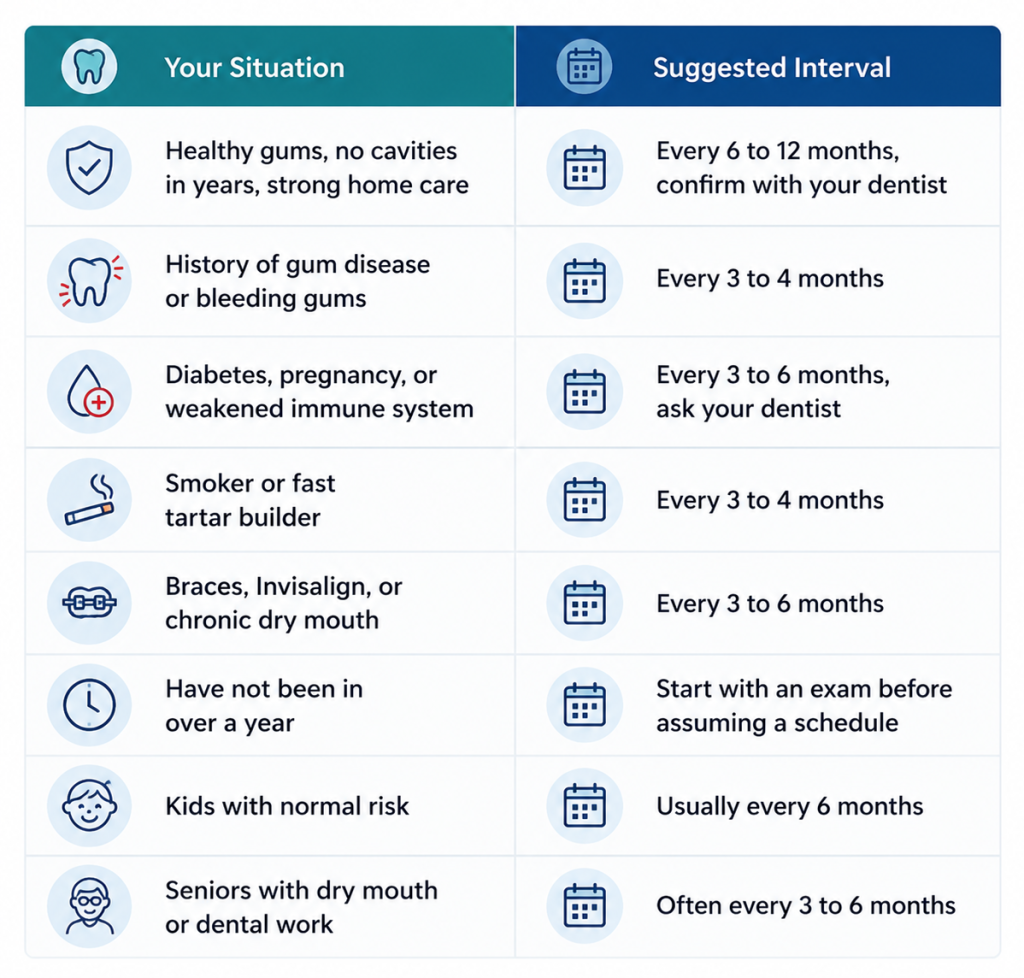
The best schedule is personal. Your dentist should look at your gums, cavity history, tartar level, medical history, and home care before giving a final answer.
What Happens If You Skip a Dental Cleaning?
Skipping one cleaning does not ruin your teeth, but regularly delaying visits can increase the risk of tartar buildup, gum problems, cavities, and hidden dental issues.
Plaque can harden and change into tartar, which irritates the gums and may lead to bleeding, swelling, or bad breath. Some problems, like small cavities or early gum disease, may not cause pain right away.
Regular cleanings help your dental team find and treat problems before they become more serious. Gum disease and problems like diabetes or heart disease are associated in research, but oral health is only one part of overall health.
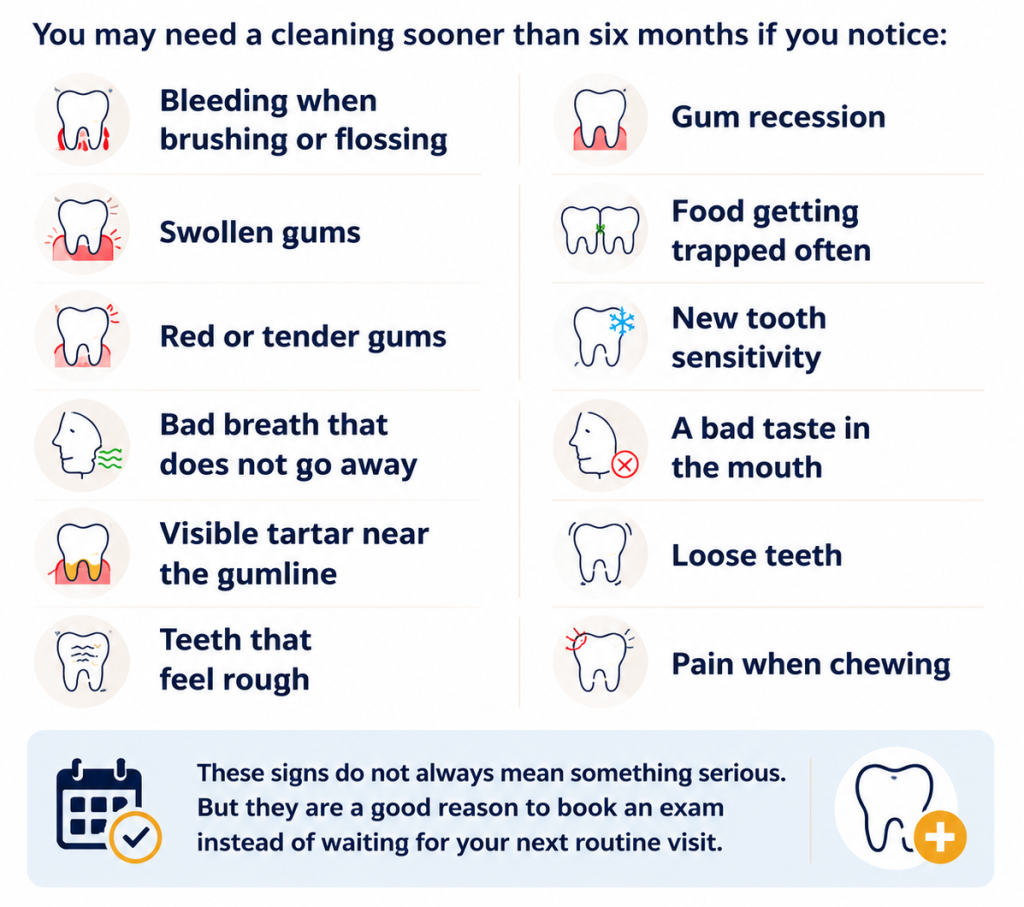
Signs You Need a Dental Cleaning Sooner
You may need a cleaning sooner than six months if you notice:
Does Insurance Cover Two Cleanings a Year?
Many dental insurance plans cover 2 cleanings per year, often at 100%. However, coverage depends on your plan, and not everyone needs the same cleaning schedule.
Some plans may also cover periodontal maintenance visits for patients with gum disease. Delta Dental notes that preventive cleanings are commonly covered, while more frequent gum maintenance may be covered when medically needed.
Dr. Foroughi’s Personal Note: Insurance can help with costs, but your cleaning schedule should be based on your gum health, cavity risk, and dentist’s recommendation.
How Atrium Dental Finds Your Right Cleaning Schedule
At Atrium Dental, we do not treat our dental cleanings in Ahwatukee like a form letter. We start with an exam, gum check, health history review, and a look at your plaque and tartar buildup.
If your gums are healthy, a routine cleaning every six months may be enough. If you have a history of gum disease, bleeding, heavy tartar, dry mouth, or other risk factors, we may recommend a shorter interval. If you are low risk, our dentist can explain whether a longer interval is safe.
Dr. Shahyar “Sean” Foroughi is the owner and lead dentist at Atrium Dental in Ahwatukee. He earned his DDS from UCSF in 2000, is a member of the AACD and the Academy of Osseointegration. He has been practicing dentistry since 2000, and has owned Atrium Dental since 2004.
Atrium Dental helps patients in Ahwatukee, Phoenix, Tempe, Chandler, and nearby South Mountain plan preventive care, routine cleanings, gum care, and family dentistry based on their needs.
Contact Atrium Dental to examine your teeth and gums, explain your risk level, and help you decide when to book your next cleaning:
- Visit us at 4425 E. Agave Rd. #130, Phoenix, AZ 85044.
- Call us at (480) 940-4321.
FAQs
How often should you get dental cleanings?
Most people need dental cleanings every six months. Your dentist may suggest another schedule based on your gums, cavity risk, tartar buildup, and health history.
How often should you get a deep cleaning?
A deep cleaning is not routine. It is used when gum disease is diagnosed, then often followed by periodontal maintenance every three to four months.
Can you go a year without a dental cleaning?
Some low-risk adults may be able to go one year, but a dentist should confirm that it is safe. Do not assume you are low risk without an exam.
How do I know if I need a cleaning sooner than six months?
Bleeding gums, swollen gums, visible tartar, bad breath, rough-feeling teeth, or a history of gum disease are signs to book sooner.