
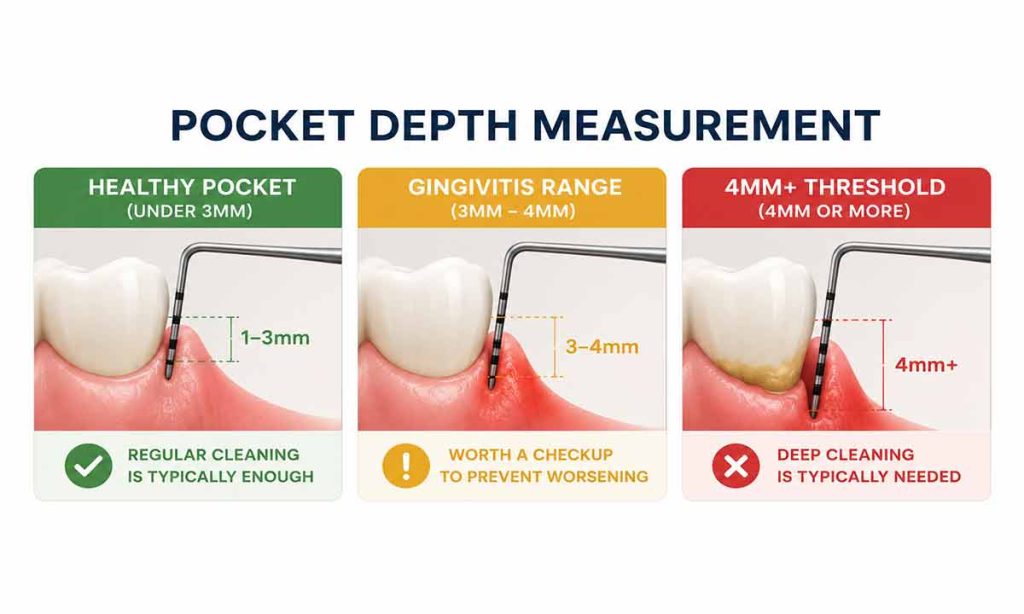
Reviewed by Dr. Shahyar Foroughi, D.D.S.
Last Updated: July 2026
Reading Time: 8 Minutes
You went in for your usual cleaning. Instead, your dentist said you need a deep cleaning. Now you’re here, phone in hand, trying to figure out what that actually means before you agree to anything.
Here’s the real difference in deep cleaning vs regular cleaning teeth. Regular cleaning cleans above the gumline. Deep cleaning cleans below the gumline. It isn’t about how thorough the cleaning is, it’s about what’s happening beneath the surface, measured in millimeters, not a feeling or a guess. Regular cleaning maintains healthy gums. Deep cleaning treats a diagnosed level of gum disease.
In this blog, we’ll break down exactly what separates the two and will tell which one you actually need.
What is a Regular Dental Cleaning?
A regular or routine dental cleaning, also called prophylaxis, is preventive care for patients with healthy or mostly healthy gums. It’s recommended when your pockets stay under 4mm and there’s no bleeding or bone loss. During the appointment, your hygienist scales away plaque and tartar from above and slightly below the gumline, then polishes your teeth to smooth the surface.
What Is a Deep Cleaning?
A deep cleaning, also called scaling and root planing, is a treatment for diagnosed gum disease, not a routine service. It’s recommended once your pockets measure 4mm or more, with bleeding or bone loss confirmed. During this general dental service, your dentist numbs the area with local anesthesia, then scales below the gumline and smooths the root surface to remove bacteria and calculus the gum tissue was hiding.
Dental Deep Cleaning vs Regular Cleaning: The Differences
Let’s dig deeper into the differences between dentist deep cleaning vs regular cleaning:
Frequency and Follow-Up
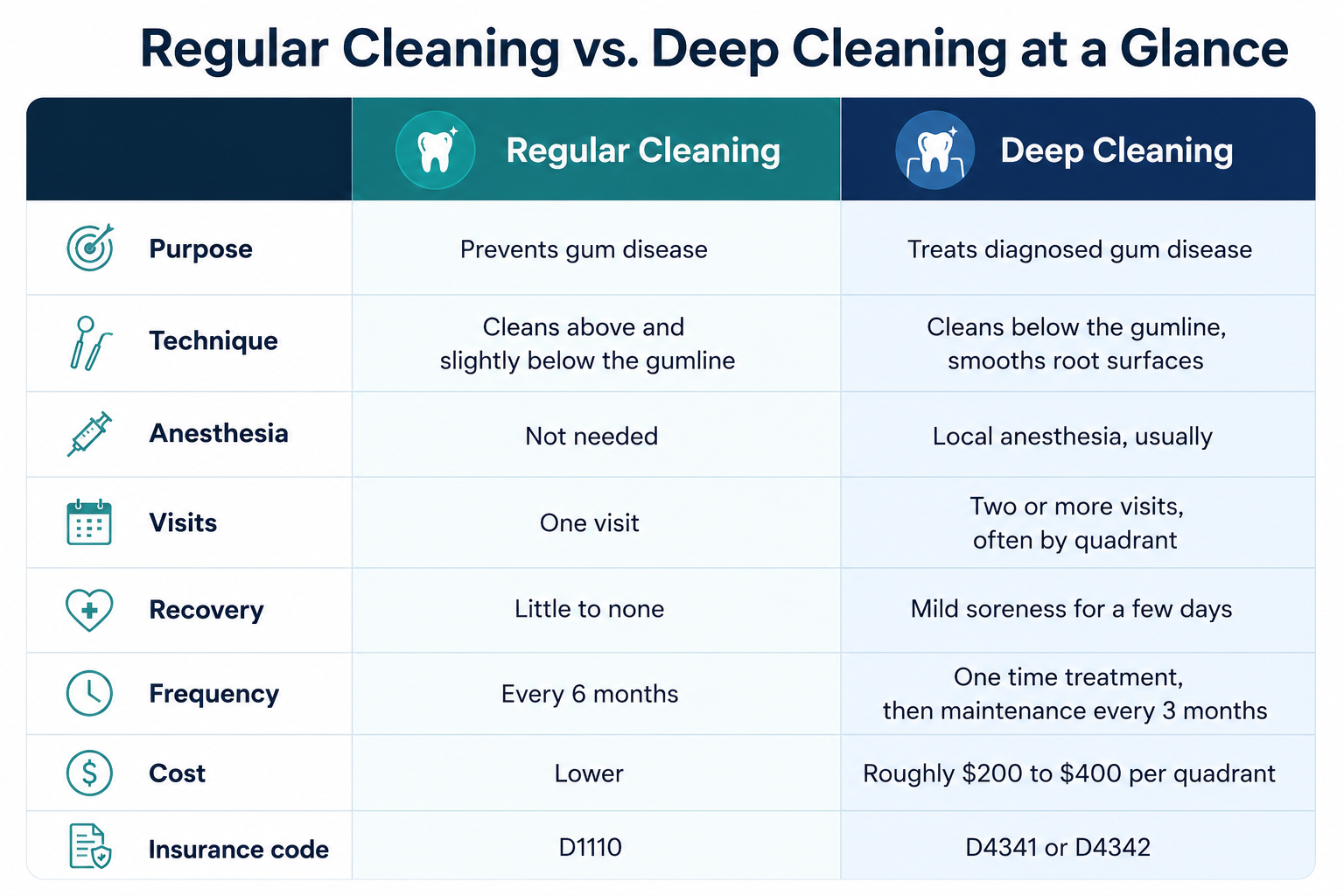
Regular cleaning stays on a normal 6 month schedule. Scaling and root planing needs a checkup every 3 months instead, because germs below the gumline tend to come back on roughly that timeline. This isn’t the same charge twice, it’s a different code for a different problem, which is also why your insurance treats the two on separate schedules.
Tools and Anesthesia
Regular cleaning uses a scaler and polisher, no numbing needed. Deep dental cleaning uses stronger tools below the gumline, so your dentist numbs the area first. That’s simply because the root surface can feel more than the crown surface, not because the treatment is harsher than it needs to be.
Benefits
Regular cleaning keeps healthy gums healthy and catches problems early. Deep cleaning teeth treats an active infection, helps slow or stop more bone loss around your teeth, and has real health effects beyond your mouth. Studies show it can improve blood sugar control in people with type 2 diabetes by about 0.3 to 0.5 percent, close to the effect of adding a second diabetes medicine. Gum disease itself has also been linked to a higher risk of heart disease, since the same inflammation that damages your gums can affect your blood vessels too.
Disadvantages
Routine dental cleaning can’t fix gum disease once it’s already there. A deep cleaning dental service takes longer, may need numbing and more than one visit, and here’s something worth knowing upfront: pockets deeper than about 5 to 6mm are genuinely hard to fully clean, even for an experienced dentist. That doesn’t mean the treatment fails, it just means very deep pockets sometimes need extra monitoring, a follow up cleaning, or additional treatment to fully resolve.
Recovery and Sensitivity
Dentist regular cleaning has little to no recovery time. After a teeth deep cleaning, mild soreness, a little bleeding, and sensitivity to cold for a few days are normal. A saltwater rinse and skipping very cold or hard foods for a couple of days both help. If soreness lasts longer than that, it’s worth a call to your dentist’s office.
What Pocket Depth Requires a Deep Cleaning?
This is really the whole answer to deep cleaning vs regular cleaning teeth. Dentists measure the space between your gum and tooth in millimeters, and that single number, more than anything your teeth look or feel like, decides which cleaning you actually need.
When Your Dentist Will Recommend Regular Cleanings
Your dentist will recommend a regular cleaning if your pockets measure 1 to 3mm, your gums look healthy, and there’s no bleeding on probing or bone loss on X-rays.
When Your Dentist Will Recommend a Deep Cleaning
Your dentist will recommend a deep cleaning once your pockets reach 4mm or more.
- At 4 to 5mm, this usually means early gum disease, especially with bleeding on probing or bone loss visible on X-rays.
- At 5 to 6mm, it points to moderate gum disease that needs closer monitoring afterward.
- At 7mm or more, it’s advanced gum disease, and even a thorough deep cleaning may struggle to fully reach that depth, so your dentist may also talk about extra treatment or follow up care.
Is Deep Cleaning Just an Upsell?
This is a fair question, and it deserves a straight answer. A legitimate deep cleaning recommendation should come with documented pocket depths of 4mm or more, bleeding on probing, and bone loss visible on X-rays. Your dentist should be able to show you these measurements.
Insurance requires this same documentation before it will pay a D4341 or D4342 claim at all. That means there’s already a built-in check against unnecessary treatment, since the insurance company won’t pay without proof.
It also helps to know how common this is. Roughly 47.2% of adults over 30 in the United States have some level of periodontitis, according to CDC data. If you’re told you need a deep cleaning, you’re far from alone, and it’s not automatically a red flag.
Self-Check: Which One Do You Probably Need?
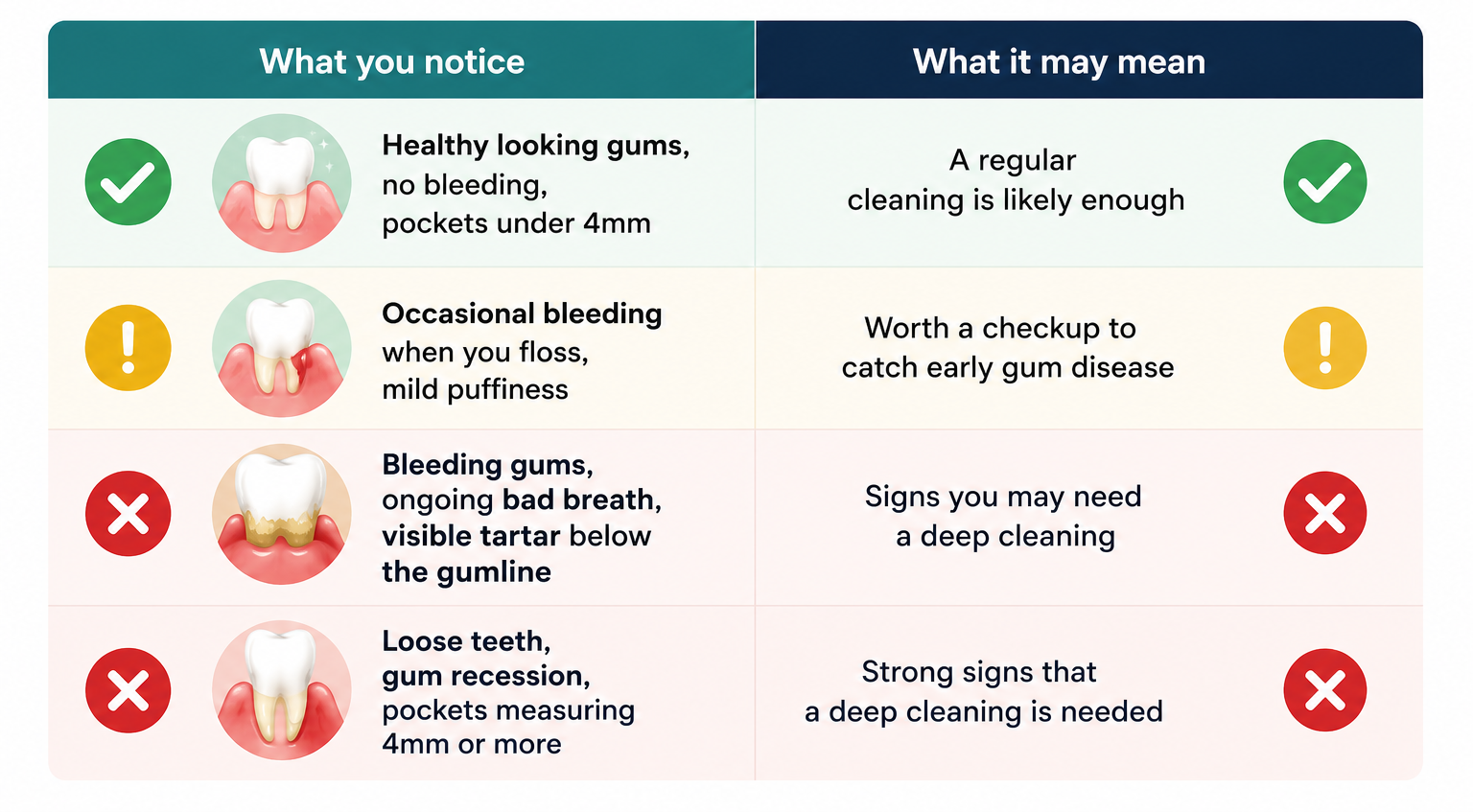
A few signs are worth paying attention to. Bleeding gums, bad breath that doesn’t go away, gum recession, visible tartar below the gumline, and loose teeth are all reasons to get checked.
Can I Choose a Regular Cleaning Instead of a Deep Cleaning?
Not once gum disease is confirmed. If your pockets measure 4mm or more with bleeding or bone loss documented, a regular cleaning simply can’t reach or treat the infection below the gumline. Most dental offices won’t substitute one for the other at that point, since doing so would leave the disease untreated and, in many cases, isn’t something insurance will even cover as a regular cleaning once periodontitis is diagnosed.
If your measurements come back healthy, under 4mm with no bleeding or bone loss, then a regular cleaning is exactly what you need, and there’s no reason to push for anything more.
Laser-Assisted Dental Cleaning in Ahwatukee
At Atrium Dental (4.8-star rating on Google), we offer laser-assisted gum therapy as a gentler alternative to traditional scaling instruments. We measure your gum health directly instead of guessing. Dr. Foroughi checks your pocket depths, looks for bleeding on probing, and reviews your X-rays for bone loss before recommending a regular cleaning or a deep cleaning. We also offer gum disease treatment, laser-assisted gum therapy, and gingivectomy for more advanced cases, alongside routine dental exams and cleanings.
We help patients in Ahwatukee, Phoenix, Tempe, Chandler, and nearby South Mountain understand their gum health and decide, with clear measurements in hand, whether a regular cleaning or a deep cleaning is the right next step.
Not sure about the difference between deep cleaning and regular cleaning teeth for your situation? Call us at (480) 940-4321 or visit us at 4425 E. Agave Rd. #130, Phoenix, AZ 85044. We’ll walk you through your results and explain exactly what they mean before recommending any treatment.
This article is for educational purposes and isn’t a substitute for an in-person dental diagnosis.
FAQs
Why is a deep cleaning important?
It treats gum disease below the gumline that a regular cleaning can’t reach. Untreated gum disease is linked to a higher risk of tooth loss, and to broader health effects including blood sugar control and cardiovascular risk.
Why do I need a deep cleaning if my teeth look fine?
Gum disease develops below the gumline, where it isn’t visible. Pocket depth measurements can reveal a problem long before it shows in the mirror.
Does a deep cleaning hurt?
Local anesthesia is used, so the procedure itself shouldn’t hurt. Mild soreness, minor bleeding, and cold sensitivity for a few days afterward are normal.
When is deep cleaning necessary versus avoidable?
It’s necessary once measured pocket depth, bleeding on probing, and bone loss confirm gum disease. It’s avoidable when your gums are healthy and your pockets stay under 4mm.
Is deep cleaning better than regular cleaning?
Neither is better. They treat different situations. Deep cleaning only applies once gum disease is diagnosed.
How long can I go without a deep cleaning?
Once it’s clinically indicated, delaying it allows pocket depth and bone loss to progress, which can make future treatment more involved.
Can you go back to regular cleanings after a deep cleaning?
Yes. Once your gum disease is under control and your pocket depths stabilize under the disease threshold, a standard six month schedule can resume, confirmed through ongoing measurements.