
Last Updated: July 2026
Reading Time: 8 Minutes
Crowded teeth are hard to live with. They overlap, twist, and trap food in places your toothbrush can’t reach. Many people also feel self-conscious smiling in photos because of it. Many people search “can Invisalign fix crowded teeth?” online, but some pages promise a straight smile in months, while others hint your case might be the one that doesn’t work out. So which is it?
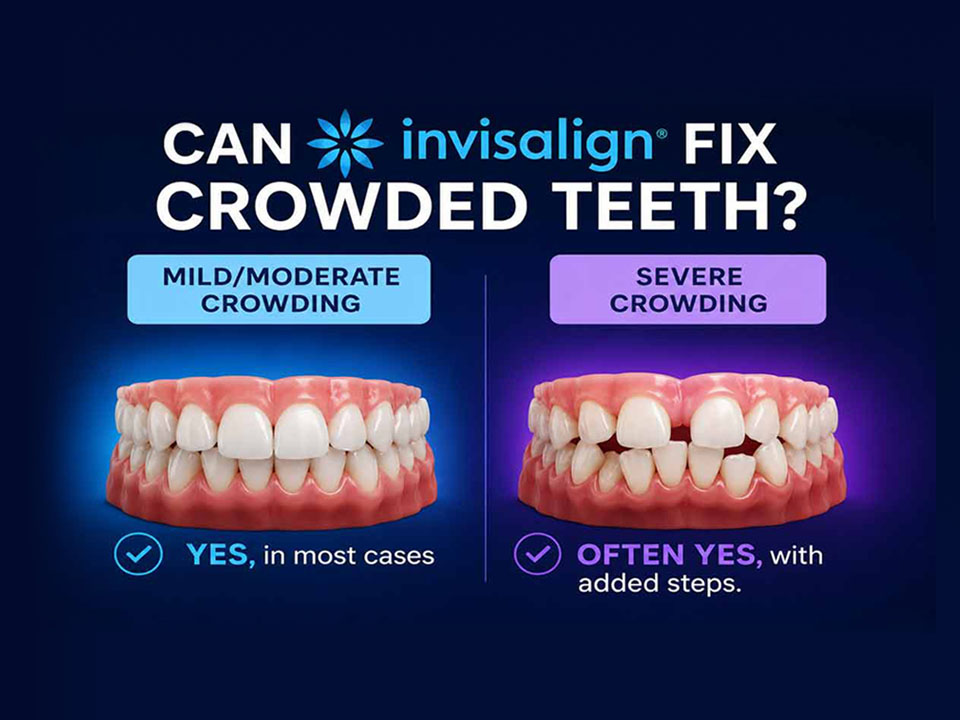
Honestly, yes! Using Invisalign for crowded teeth works in most cases. Mild crowding usually takes about 13 months, moderate about 16, and severe about 18, sometimes longer if enamel reduction or braces are needed first. Studies show it can reduce crowding of the bottom front teeth by up to 91.4%, with an overall 80.9% improvement in crowding measured against fixed braces.
In this blog, we’ll break down if Invisalign can fix crowded teeth and exactly how your crowding severity affects your timeline and your results.
What Is Dental Crowding?
Crowding is a type of malocclusion. That’s just a medical term for teeth that don’t line up the way they should. It happens when your jaw doesn’t have enough room for all your teeth to sit flat, so they overlap, twist, or rotate instead.
Crowding isn’t just a cosmetic issue. It makes brushing and flossing harder, since the tight spots trap plaque your brush can’t clean well. Over time, that raises your risk of cavities and gum irritation. Crowding can also wear your bite unevenly, and some people feel jaw discomfort from it too.
Left untreated, crowding can quietly raise your risk of decay and gum disease for years without you noticing. That’s the real reason people use Invisalign. It uses a series of clear trays that you swap every one to two weeks, each one nudging your teeth a little closer to where they belong.
How Much Crowding Can Invisalign Fix?
How effective Invisalign is for crowded teeth mostly comes down to how severe it is. Dentists measure this in millimeters using the Little’s Irregularity Index.
| Severity | Measurement | What it looks like | Can Invisalign fix it? |
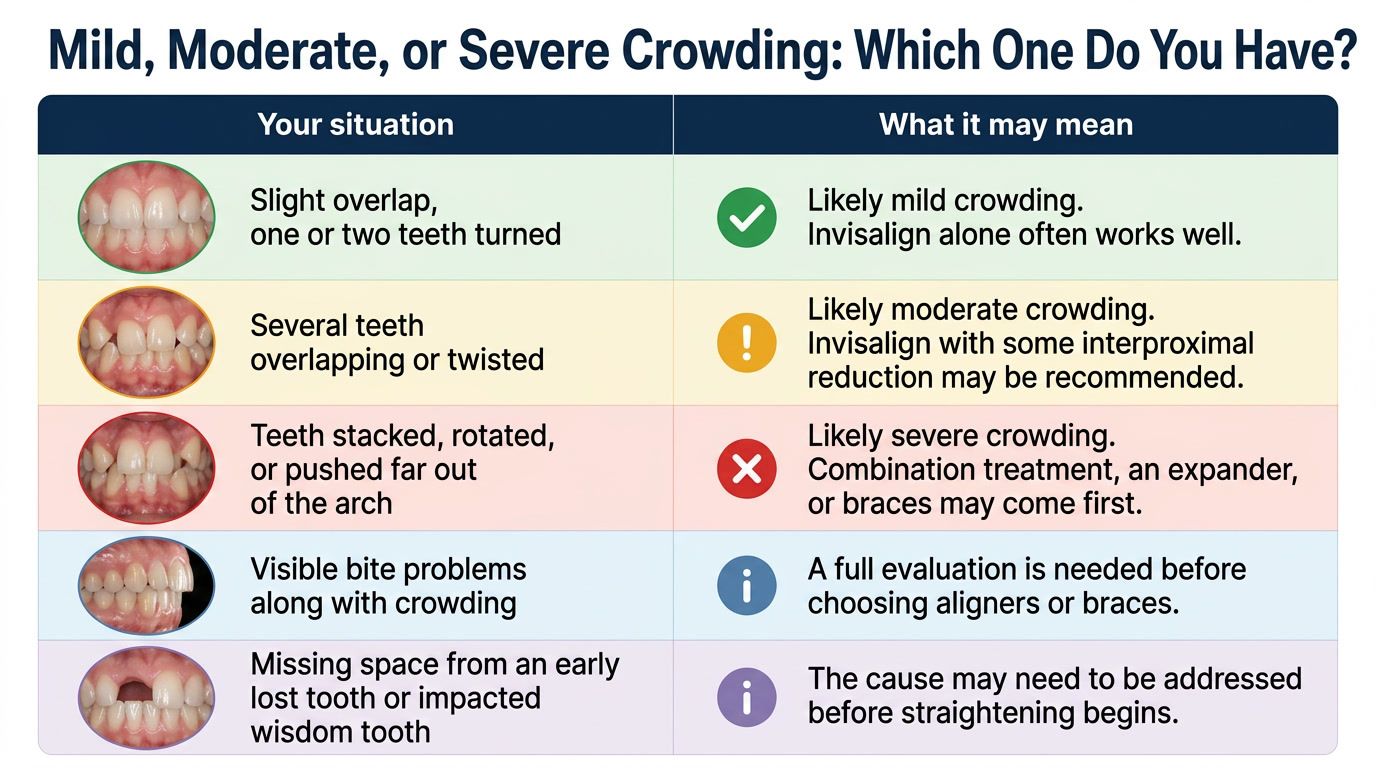
| Mild | 2.0 to 3.9mm | A slight overlap or rotation in one or two teeth | Yes, usually with Invisalign alone |
| Moderate | 4.0 to 5.9mm | Several teeth overlapping or twisted | Yes, often combined with a small amount of enamel reduction for extra space |
| Severe | 6.0mm or more | Teeth stacked, rotated, or pushed out of the arch | Often yes, but usually needs added steps like arch expansion, combination treatment, or a period of braces first |
Crowding also shows up differently depending on where it is in your mouth, and these cases follow the same severity rules above.
| Type | What it looks like | Can Invisalign fix it? |
| Front teeth crowding | Visibly overlapping or crooked teeth on the top or bottom arch, the most common complaint people bring up | Usually treatable, since severity matters more here than location |
| Single tooth crowding | One crooked or overlapping tooth, often from a baby tooth that fell out too early or too late | Typically one of the easier cases to correct |
| Bottom teeth crowding | Crowding isolated to the lower arch | Responds well in most mild to moderate cases, and it’s one of the most studied presentations in clinical research |
If you have visible bite problems along with your crowding, or if it came from an early lost tooth or an impacted wisdom tooth, a full evaluation is needed before deciding on any treatment.
What Causes Crowded Teeth?
A few things usually cause crowding.
- Your jaw is smaller than the space your teeth need
- Genetics, since jaw size and tooth size are often inherited separately from each other
- Thumb or pacifier sucking as a child
- Losing a baby tooth too early, which lets nearby teeth drift into the open space
- Impacted wisdom teeth pushing the rest of your teeth forward
Impacted wisdom teeth are the reason dentists sometimes recommend wisdom teeth removal before or during orthodontic treatment.
How Invisalign Fixes Crowded Teeth, Step by Step
Invisalign moves your teeth gradually using a series of custom clear trays. Here’s what the process actually looks like.
- Your dentist examines your teeth and confirms your crowding severity, ruling out any gum or bite issues.
- A 3D scan maps your teeth and plans the movement digitally before any trays are made.
- Technicians custom make your aligners in a series, sometimes adding small tooth colored attachments to grip teeth that need to rotate.
- Your dentist schedules a small amount of enamel reduction at specific stages if you need extra space.
- You wear each tray 20 to 22 hours a day and swap it for the next one every one to two weeks.
- Your dentist checks your progress along the way, and about one in three patients need a round of refinement aligners to fine-tune the result, which is normal and doesn’t mean anything went wrong.
- You wear retainers afterward to hold your new smile in place.
Can Invisalign Fix Severe Crowding?
Yes, Invisalign for severe crowding can work in most cases, but it usually needs more than trays alone. Dentists often add a small amount of enamel reduction, arch expansion, or a combination approach with braces to create enough space. In some cases, extraction or a period of braces first is needed before aligners can finish the job.
There’s a nuance worth knowing here too. Research shows that in cases with 6mm or more of crowding, the lower front teeth can tip and flare forward slightly as space is created. Mild and moderate cases don’t show this same shift. This is exactly why severe cases need closer planning and monitoring, not a simple yes or no answer.
Will My Teeth Be Shaved or Removed?
This is one of the biggest fears people have, so let’s clear it up. If you’ve spent any time reading through dental forums, you’ve probably seen someone say no to Invisalign the moment they heard their teeth might be filed. That reaction makes sense on the surface, but the actual process is much smaller than it sounds.
It’s called interproximal reduction, and it removes a small, painless amount of enamel, usually 0.2 to 0.5mm, from between select teeth. It’s sometimes done at a few contact points to gain a few millimeters of total space.
This is not the same procedure used to prepare teeth for veneers. It’s much smaller and only happens between certain teeth, not across the whole tooth surface. Extraction only comes up if the space needed goes beyond what enamel reduction or expansion can safely provide.
How Long Does Invisalign Take for Crowded Teeth?
Treatment time for Invisalign on crowded teeth depends on your severity level, based on a systematic review of clinical outcomes.
| Severity | Average treatment time |
| Mild | About 13 months |
| Moderate | About 16 months |
| Severe | About 18 months |
Dr. Foroughi’s Tip! These are averages, not guarantees. Wearing your trays the full 20 to 22 hours a day matters a lot for staying on schedule, and needing refinement aligners partway through can add time too.
Are You a Good Candidate for Invisalign If You Have Crowded Teeth?
You’re likely a good candidate if most of these apply to you:
- Your crowding is mild to moderate, with teeth overlapping but no major bite or jaw problems.
- Most of your permanent teeth have already come in, which usually happens by the early teen years, though this varies person to person.
- You’re ready to wear your aligners 20 to 22 hours a day and only take them out to eat, drink, and clean your teeth.
- Your gums and teeth are healthy, or you already have a plan to treat any issues first.
Dr. Foroughi’s Tip! You may need a closer evaluation before starting if your crowding looks severe, with teeth clearly rotated or pushed out of the arch. The same goes if you have untreated cavities or gum disease, or if you know you won’t be able to commit to near constant daily wear.
Possible Challenges and Solutions for Invisalign for Crowded Teeth
- You may need small tooth colored attachments placed to help your aligners grip rotated teeth. These are temporary and painless.
- Pressure or soreness with a new tray is normal for the first day or two, then it settles down.
- Needing refinement aligners happens in a meaningful share of cases. It’s a normal part of fine-tuning your treatment, not a sign it failed.
- Some patients notice a temporary lisp early on that fades with practice.
- Staying disciplined with wear time matters more than almost anything else, since missed hours slow your progress.
- Keeping your trays clean takes a bit of routine. Plaque can build up on them if you skip rinsing and brushing them each time you take them out, so a quick clean prevents that from becoming annoying later.
- Some patients go in expecting a certain timeline based on general information they read beforehand, then find out their actual scan calls for more or less time than they assumed. That’s normal, and it’s exactly why the exam and scan matter more than any average number online.
- In severe cases, front teeth can flare slightly as space is created, but this is monitored through scans and adjusted as needed.
Will Crowding Come Back After Invisalign?
This is rarely covered elsewhere, so let’s be direct about it. Research shows aligner-treated teeth can relapse more than braces-treated teeth, especially in the upper arch, if retainers aren’t worn as directed.
A bonded or removable retainer, worn consistently, is what actually protects your result long term. Most patients wear retainers full time at first, then switch to nighttime wear only. Skipping this step is the most common reason crowding creeps back after treatment.
Alternatives If Invisalign Isn’t the Right Fit
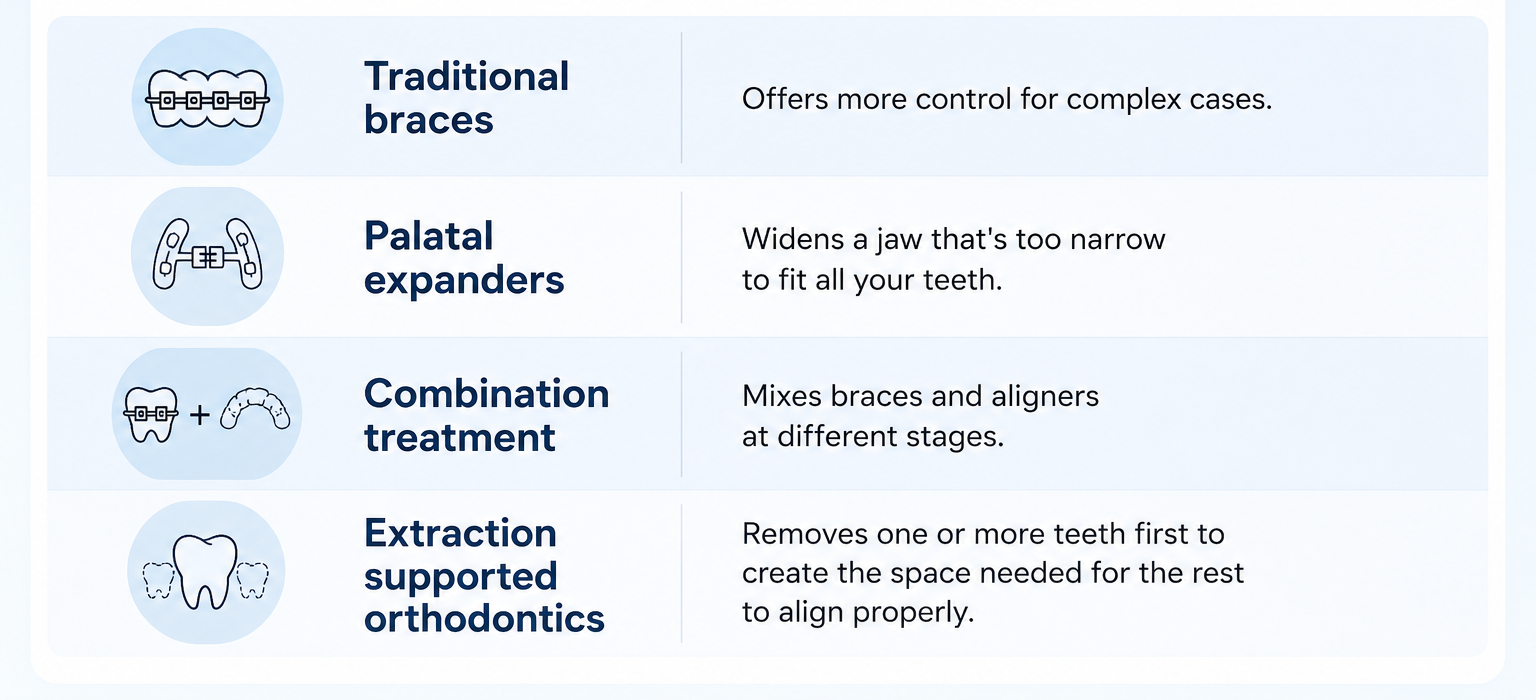
If Invisalign isn’t the best match for your crowding, a few other paths are worth knowing about. All of these are normal, well-established Invisalign for crowded teeth alternatives:
Clear Aligners for Crowded Teeth Near Me in Ahwatukee, Phoenix
At Atrium Dental (4.8-star rating on Google), we offer Invisalign for crowded teeth. Our dentist, Dr. Foroughi, earned his DDS from UCSF in 2000 and graduated Magna Cum Laude in Biological Sciences from USC in 1995.
Before recommending Invisalign in Ahwatukee, Dr. Foroughi checks
- The amount and location of your crowding
- Your bite alignment
- Your gum and enamel health
- How much space is available for tooth movement
- Whether enamel reduction, expansion, or combination treatment is the right call for your case.
We help patients in Ahwatukee, Phoenix, Tempe, Chandler, and nearby South Mountain find out whether Invisalign, a combination treatment, or traditional braces is the right way to fix their crowding.
Ready to find out if Invisalign can fix your crowding? Call us at (480) 940-4321 or visit us at 4425 E. Agave Rd. #130, Phoenix, AZ 85044.
This article is for educational purposes and isn’t a substitute for an in-person dental diagnosis.
FAQs
Does Invisalign work for crowded teeth?
Yes, for most mild to moderate cases. Clinical studies show it can resolve up to roughly 91% of lower front tooth crowding, with severe cases sometimes needing extra steps.
Can Invisalign fix crowded lower teeth?
Yes. Lower front tooth crowding is one of the most studied and successfully treated cases in clinical research.
How much does Invisalign for crowded teeth cost?
Cost depends on how complex your case is and how long treatment takes. Many dental insurance plans cover part of it as an orthodontic benefit. An exam gives you an accurate estimate for your case.
How much crowding is too much for Invisalign?
There’s no universal cutoff. Crowding is measured in millimeters as mild, moderate, or severe, and even severe cases are often treatable with added steps like enamel reduction or combination treatment, confirmed through an exam.
Can Invisalign fix crowded front teeth?
Yes, front tooth crowding, including overlapping or rotated teeth, is one of the most common cases Invisalign treats.
Can Invisalign fix crowded teeth without extraction?
Yes, most crowding, including severe cases, can be treated without extraction using enamel reduction, arch expansion, or combination treatment. Extraction is only needed when the space required goes beyond what those options can safely provide.