
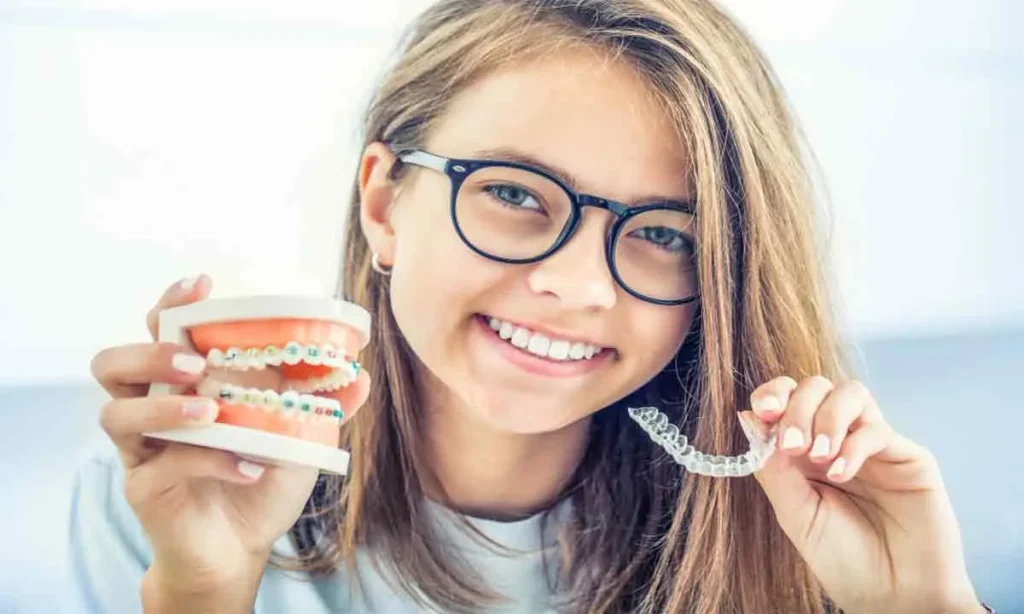
Plenty of adults live with crooked, gapped, or shifted teeth for years before they decide to fix them. Many want to do it quietly, without turning their smile into office small talk.
If you are comparing Invisalign vs braces for adults, here is the short answer. Invisalign works best for adults who want a clear, removable, and comfortable option for mild to moderate alignment problems. Traditional braces work best for complex bite problems and teeth that need strong, steady force to move. The right choice depends on your teeth, how complex your case is, your daily habits, and how well you can stick to a plan.
About 1 in 3 orthodontic patients today is an adult, according to the American Association of Orthodontists. You are not too old, and you are not alone.
Table of Contents
ToggleInvisalign vs Braces for Adults: The Differences
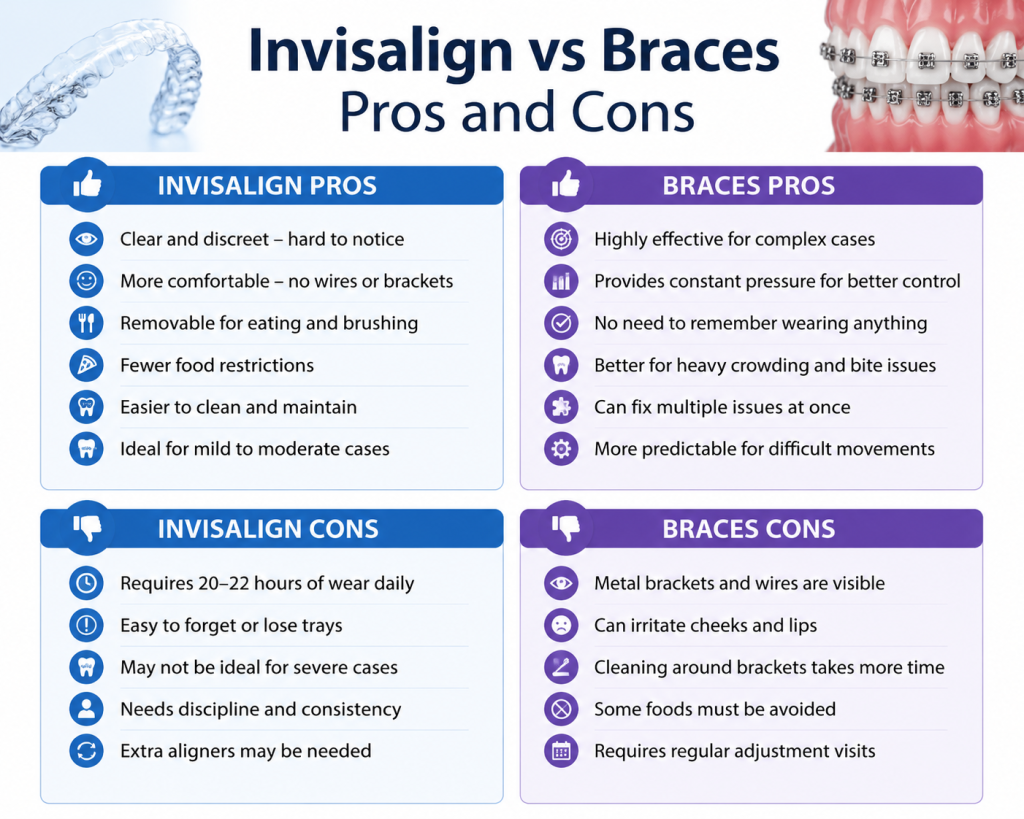
Here is how the two options compare on the things that matter most to adults:
| Factor | Invisalign | Braces |
| Appearance | Clear, blends with teeth | Metal or ceramic brackets show |
| Visibility at work | Hard to notice in meetings or on camera | Noticeable, though ceramic shows less than metal |
| Comfort | Smooth plastic, mild pressure with a new tray | Can rub or irritate cheeks and lips |
| Eating | Take them out, no food limits | Sticky and hard foods best avoided |
| Cleaning | Normal brushing and flossing after removal | Needs extra tools around brackets and wires |
| Daily effort | High, 20 to 22 hours of wear a day | Low, they stay on and need no daily choice |
| Best fit | Mild to moderate movement | Mild to complex movement, including heavy crowding |
| Typical time | About 12 to 18 months for mild to moderate cases | About 18 to 24+ months, longer for complex cases |
Comfort and Daily Wear
Invisalign trays are smooth plastic. They have no wires or brackets that can rub your cheeks or lips raw. A new tray in the set can feel tight or sore for a day or two, then it settles. Braces stay on your teeth all the time, so there is no tray to put in or take out. But the brackets and wire ends can irritate your cheeks and lips, especially right after an adjustment visit.
Appearance
Invisalign trays are clear. Most people will not notice them in a normal conversation, on a video call, or in photos. Braces use metal or ceramic brackets and a wire that sits on the front of your teeth. Ceramic brackets blend in a bit better than metal, but people can still see them up close.
Treatment Time
Invisalign asks for 20 to 22 hours of wear each day, and you switch to a new tray every one to two weeks. Mild to moderate Invisalign cases often finish in about 12 to 18 months.
Braces do not need a daily choice since they stay on your teeth, but you visit the dentist every 4 to 6 weeks for an adjustment. Braces, especially for more complex cases, often take 18 to 24 months or longer.
Effectiveness for Different Dental Problems
Custom Invisalign plans tend to work well for:
- Mild to moderate crowding or teeth that overlap a little
- Small to medium gaps between teeth
- A tooth or two that turned slightly out of place
- Mild bite problems, including some overbites, underbites, or crossbites
- Teeth that shifted a little after old orthodontic work
Braces tend to work better for:
- Heavy crowding or very little room in the jaw
- Bite problems that need strong, steady force to fix
- Teeth that need a big turn or a big lift
- Several problems that need to be fixed at the same time
- Cases where a person may not wear a removable tray consistently
Maintenance and Lifestyle Impact
You take Invisalign trays out to eat, brush, and floss, so your routine stays close to normal. Trays need a daily rinse and an occasional cleaning tablet. Braces stay on around your food, so brushing and flossing take longer and often need a floss threader or water flosser. Some sticky or hard foods are best avoided.
Both options need a retainer once treatment ends to hold your teeth in place. Most people wear it full time at first, then switch to nights only. Skipping it is the most common reason teeth drift back, with Invisalign or braces.
Insurance Coverage and Payment Options
Many dental insurance plans cover Invisalign and braces the same way, under one orthodontic benefit. FSA and HSA funds can often pay for either option too. Coverage limits vary by plan, so check your benefits and ask about payment plans before you start.
Invisalign vs Braces Cost: Is Invisalign Cheaper Than Braces?
Invisalign and braces usually cost about the same overall. The final price depends on how complex your case is, how long treatment takes, and where you live.
Invisalign can cost a little more than basic metal braces in simple cases, mostly because of the 3D scan and custom trays involved. The braces for adults cost can climb higher in complex or long cases that need extra visits or extra appliances. Neither option wins on price once your specific case is factored in.
Invisalign vs Braces: Which is Faster?
In many simple adult cases, yes, Invisalign finishes faster than braces, often in about 12 to 18 months compared to 18 to 24 months or more for braces. But that answer flips in complex cases. When teeth need heavy rotation or a bigger bite correction, braces tend to be the steadier, more predictable path, even if the total time ends up close to the same.
Some research shows braces control tooth rotation and back tooth bite contact a bit better in tough cases. That is worth saying plainly instead of glossing over it. It is also normal to need extra aligners partway through Invisalign treatment to fine-tune the result. That is not a sign something went wrong.
Invisalign vs Braces for Adults: Which is Better for You?
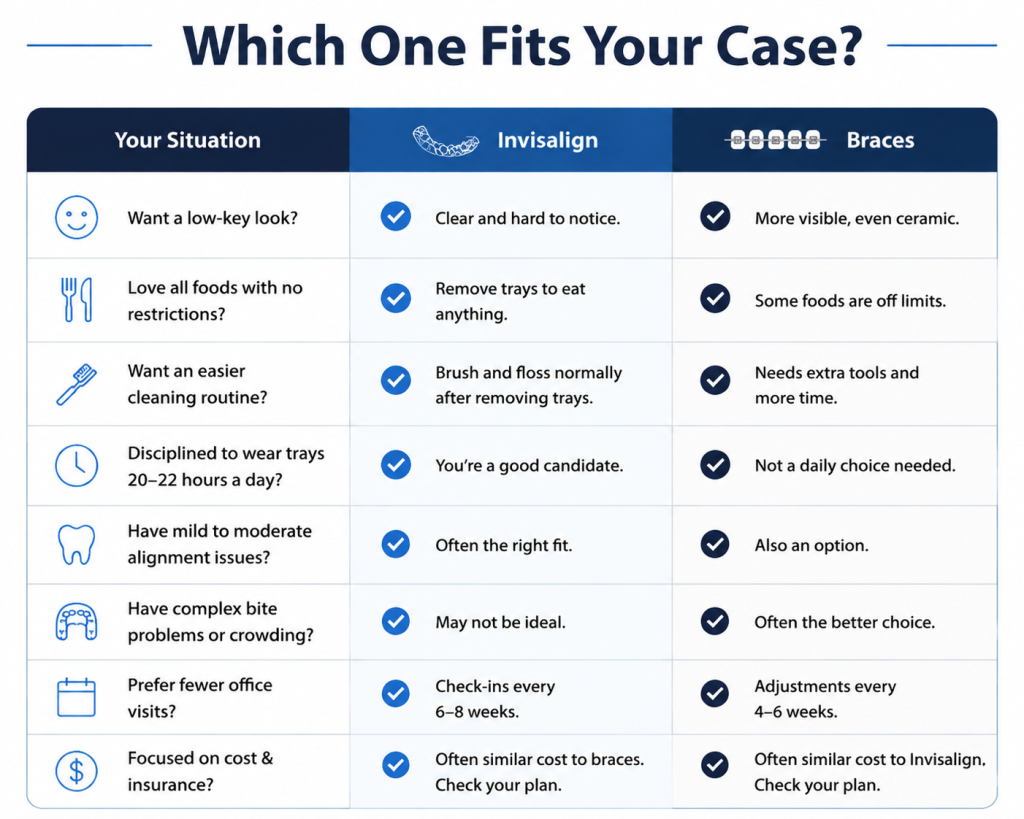
Think about your daily life, not just your teeth, when you choose.
Invisalign tends to fit best when:
- Your crowding or gaps are mild to moderate.
- You work in a role where people see your face often, like sales or client meetings.
- You want to take your trays out for meals or big events.
- You can wear your trays most of the day without forgetting.
- You would rather have fewer office visits.
- You are coming back for a mild second round after teen braces.
Benefits of braces over Invisalign show themselves best when:
- Your case is more complex, like heavy crowding, a bite correction, or several teeth that need to turn.
- You would not wear a removable tray for 20+ hours a day.
- You want a treatment that works around the clock on its own.
- You have more than one problem to fix at once.
- Your dentist finds a bite or jaw issue that needs close, steady control.
Why Do Dentists Recommend Invisalign So Often?
So why do dentists push Invisalign? Here are the real reasons dentists bring it up so often:
- Adults ask for it by name. Most patients already know what Invisalign is and want a straighter smile without visible metal, so dentists mention it early.
- It fits how adults live. Removable trays work better with jobs, dating, travel, and eating out than fixed brackets do.
- It is often a good match for the cases dentists see most. A large share of adult patients have mild to moderate crowding or gaps, which Invisalign handles well.
None of that means it is right for every case. A good recommendation should come from your bite, not from what sells best. If your dentist tells you braces fit your case better, that is a sign of an honest dental exam.
Is It Too Late to Get Braces or Invisalign as an Adult?
No. There is no age limit for Invisalign or braces, as long as your teeth and gums are healthy enough to move. Two things make adult cases a bit different from a teenager’s case: teeth that shifted back after you stopped wearing a retainer years ago, and the gum or bone changes covered above. Neither one rules you out. They just mean your dentist checks a few more things before you start.
Special Considerations for Adult Teeth and Gums
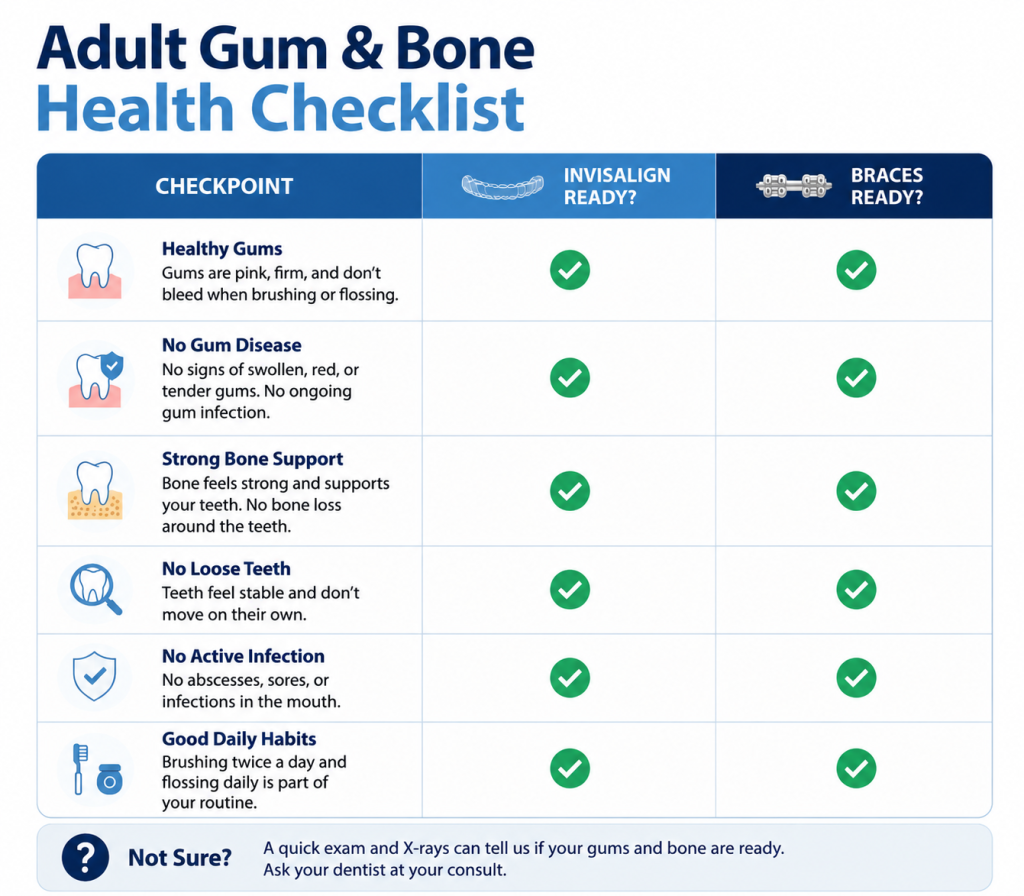
Adult mouths are not the same as teen mouths. Years of wear, past dental work, and gum health all play a part in which treatment fits best. A gum check matters more for adults than it does for teens, since gum disease and bone loss become more common with age.
If your gums have pulled back or your jawbone has thinned, your dentist may need to treat that first or adjust your plan. Crowns, bridges, or missing teeth can also change what is possible with either option. None of this should stop you from asking about treatment. It is simply why a full exam comes first.
Already Had Braces as a Kid? What Changes the Second Time Around
If your teeth shifted after you stopped wearing your retainer, you are not alone. This kind of relapse is common. A second round of treatment, with Invisalign or adult braces, often moves faster than your first round did, since the shift is usually mild. Even so, your dentist should still run a full exam rather than assume your old treatment plan still fits. Your teeth, gums, and bite may have changed since then.
Invisalign Ahwatukee, Phoenix: What to Expect at Atrium Dental
Dr. Shahyar Foroughi has practiced dentistry for more than 25 years and earned his DDS from UCSF. He starts with a full exam and a 3D iTero scan for Invisalign, then gives you an honest read on which option fits your case. If Invisalign is right for you, you get a custom Invisalign plan, regular check-ins, and a retainer once treatment ends. If your bite needs closer work first, that starts with a full dental exam.
Atrium Dental, named Best of Ahwatukee from 2023 to 2025, helps adults in Ahwatukee, Phoenix, Chandler, Tempe, and South Phoenix find the more predictable path for their smile.
Rated 4.8 stars on Google, our team can check your bite and gum health, then walk you through what honestly fits your case. Visit us at 4425 E. Agave Rd. #130, Phoenix, AZ 85044, or call (480) 940-4321 to set up a consultation.
Our office hours:
- Monday & Wednesday: 8:00 AM – 5:00 PM
- Tuesday & Thursday: 9:00 AM – 6:00 PM
- Friday – Sunday: Closed
FAQs
Is Invisalign as effective as braces for adults?
Yes, for most mild to moderate cases. If your bite is complex or your crowding is heavy, braces or a mix of both often work better.
Is Invisalign cheaper than braces?
Not always. The two options usually land in a similar price range. Your case, your insurance, and how long treatment takes decide the real cost.
Why don’t orthodontists like Invisalign?
Most do use it, just not for every case. Some cases need more force or control than trays can give, so an orthodontist may prefer braces there instead.
Is $4,000 a lot to pay for Invisalign?
No, that price sits in a normal range for many cases and cities. A consult gives you a number based on your own teeth.
Can adults get good results from orthodontic treatment?
Yes. Teeth move the same way at any age as long as your gums and bone are healthy. Your result depends on your case and how well you follow the plan, not your age.
Will I need to wear a retainer after my treatment is finished?
Yes, with either option. A retainer worn as directed is what keeps your teeth from drifting back once treatment ends.
Will people notice I am wearing Invisalign at work?
Most will not, especially if you do not need attachments. The trays are clear and sit close to your teeth.