
Invisalign vs Braces for Adults: Which Is Better?
August 9, 2026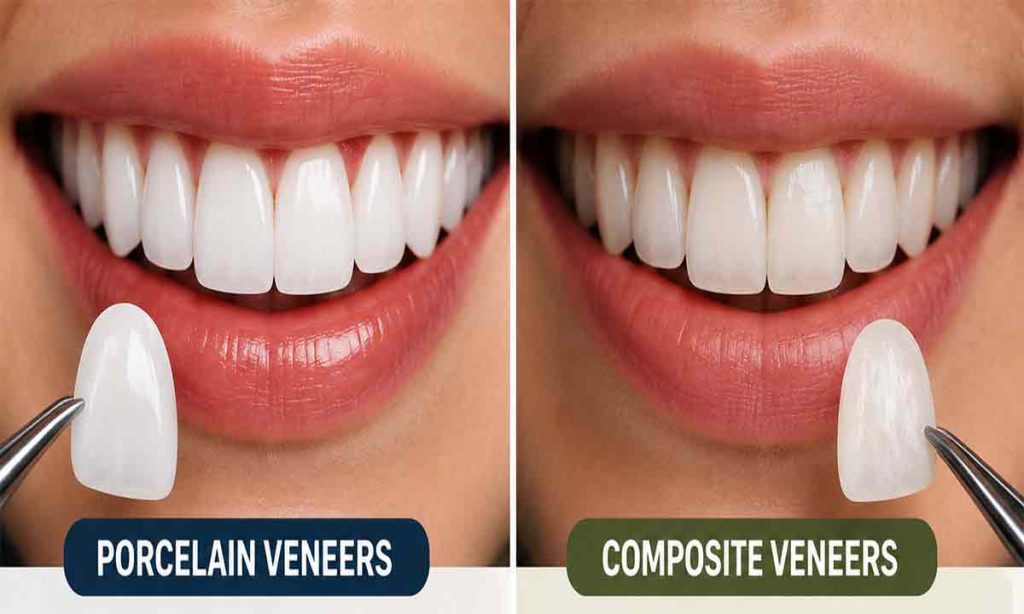
You already want a straighter, brighter smile, and someone told you veneers could work. Now you face the real question: porcelain veneers vs composite veneers, and which one fits your case.
The main difference between composite and porcelain veneers comes down to cost, lifespan, and how they are made. A dentist shapes composite resin veneers right on your tooth, often in one visit, and they generally cost less but last 5 to 7 years. A lab crafts porcelain veneers as custom shells, bonded on over two visits, and they cost more upfront but typically last 10 to 15 years. Composite also stays reversible in most cases, while porcelain removes enamel permanently.
This guide covers cost, look, lifespan, and whether you can switch types later, so you know which fits your own smile goals.
How Veneers Work
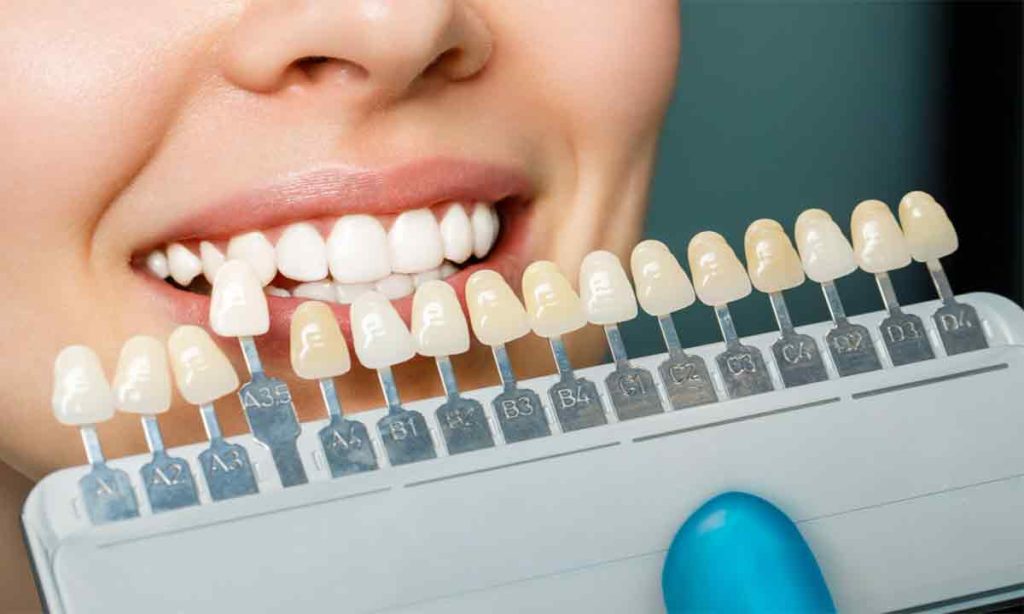
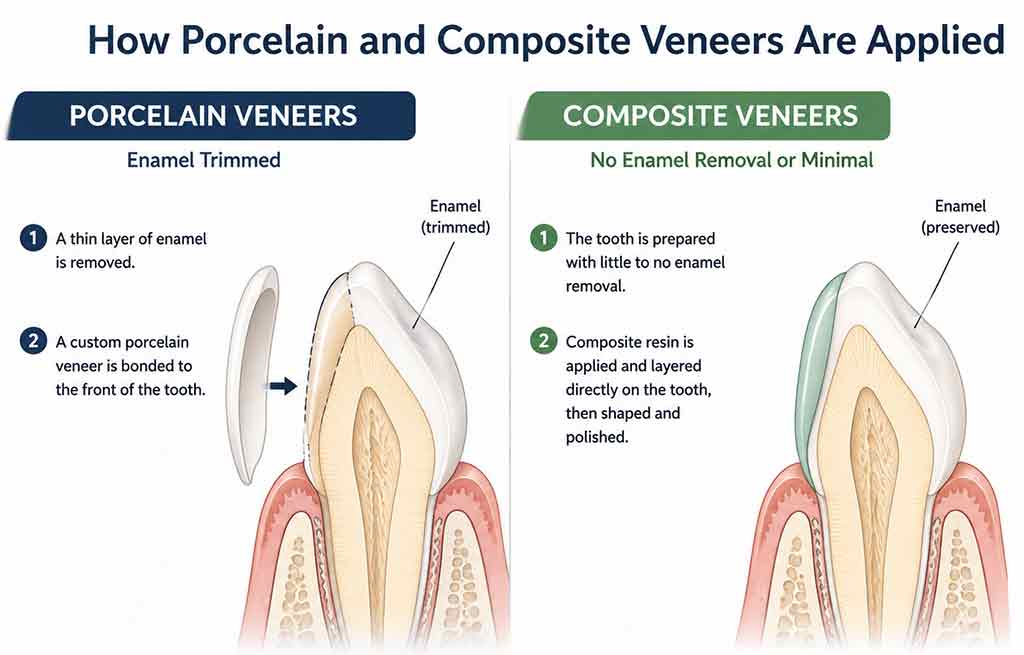
Veneers are thin shells of porcelain or composite resin. Your dentist bonds each one to the front of a tooth, right where it shows when you smile. Before your dentist places a veneer, they may remove a thin layer of natural enamel (for porcelain ones) so the new surface sits flush and looks right. Many patients fix several small issues in just one or two visits, which makes veneers a strong value for the right case.
Veneers can correct a range of small problems in one step. Here are the issues they fix most often:
- Chips
- Gaps between teeth
- Stains that whitening cannot fix
- Teeth with a slightly odd shape
- Edges that do not line up evenly
People sometimes mix up composite veneers with dental bonding. Bonding uses the same resin, but it usually fixes one small spot on a tooth rather than the full visible surface a veneer covers. Ask your dentist which one truly fits your case.
Composite Veneers vs Porcelain Veneers: What’s the Difference?
| Porcelain Veneers | Composite Veneers | |
| Lifespan / Longevity | Roughly 10 to 15 years with care | Roughly 5 to 7 years with care |
| Appointments / Time | Usually two visits, with lab time between | Usually one visit |
| Aesthetic / Look | Reflects light close to real enamel | Looks natural, may need polish over time |
| Stain Resistance | Resists stains well | Can pick up stains from coffee, wine, or tobacco |
| Repairability | A damaged shell usually needs full replacement | A chip or stain can often get a quick repair |
| Enamel Removal / Reversibility | Removes a thin, permanent layer of enamel, so the change cannot get undone | Removes little to no enamel, so the choice stays reversible in most cases |
| Cost | Composite is generally cheaper | Porcelain costs more because it needs a lab and a trained lab technician |
Composite vs Porcelain Veneers: Pros and Cons
Each material carries real strengths and real trade-offs. Here is an honest look at both.
Porcelain Veneers Pros and Cons
Porcelain veneers suit patients who want a long-term result. Here is what stands out:
- Holds up well against daily wear and stains, often for a decade or more.
- Reflects light much like real enamel.
- A lab shapes each shell to fit your bite with precision.
- Rarely needs a touch-up once your dentist places it.
Porcelain also comes with real trade-offs to weigh first:
- Removes a thin, permanent layer of enamel.
- Usually takes two visits, since a lab must make the shell.
- Costs more upfront than composite.
- A damaged shell usually needs full replacement, not a quick repair.
Composite Veneers Pros and Cons
Composite fits patients who want speed and flexibility. Here is what stands out:
- Your dentist can often finish it in a single visit.
- Removes little to no enamel, so you keep the option open to change later.
- Costs less upfront than porcelain.
- Your dentist can repair a small chip or stain quickly and at low cost.
Composite also has real limits worth knowing:
- Picks up stains from coffee, wine, and tobacco faster than porcelain.
- Usually needs a touch-up or replacement sooner than porcelain.
- Depends heavily on your dentist’s skill for a natural result.
- Can lose its shine faster than porcelain.
Composite vs Porcelain Veneers Cost
Cost varies by case, but composite veneers generally cost less than porcelain. Your dentist places composite directly at the chair, with no dental lab involved, which keeps the price lower. Porcelain costs more because it needs a lab and a trained lab technician to shape each shell from a higher-grade material.
Dental insurance usually does not cover either option, since both count as cosmetic treatment. Ask Atrium Dental for your exact price range at a consultation, since the figures here are general and not a quote for your case.
What Drives Composite vs Porcelain Veneers Cost
- The lab and technician porcelain needs to shape each shell to add real cost, while composite skips the lab since your dentist shapes the resin by hand at the chair, which keeps the price lower.
- More visits raise the cost, and porcelain needs extra appointments for impressions, lab work, and a try-in, while composite often finishes in one visit unless the case gets complex.
- The number of teeth involved changes the total the most, since one chipped tooth costs far less than a full smile, and extra prep, a bite adjustment, or work on an old filling nearby all add to the bill.
- A longer lifespan can lower the cost over time, since porcelain often lasts 10 to 15 years while composite lasts roughly 5 to 7 years and may need a repair or replacement sooner.
Porcelain vs. Composite Veneers: How Long Do They Last?
Porcelain veneers typically last 10 to 15 years with good care, and composite veneers typically last 5 to 7 years before needing repair or replacement (Layton DM, Walton TR, “An Up-to-17-Year Follow-Up Study of 304 Porcelain Veneers,” International Journal of Prosthodontics). Both ranges depend on how well you care for them, not just the material itself.
A few things shorten or extend that lifespan either way:
- Grinding or clenching your teeth at night wears down or cracks a veneer faster than normal use, on either material.
- Biting hard objects, like ice, pens, or fingernails, raises the risk of a chip, especially with composite.
- Regular checkups let your dentist catch small chips or wear early, before they turn into a bigger repair.
- Good daily brushing and flossing protect the edges where a veneer meets your natural tooth, which is where problems usually start first.
Porcelain generally resists wear and stains better than composite, which is the main reason it tends to hold up longer over time. Composite can still last toward the higher end of its range with careful use and the occasional polish.
Porcelain vs. Composite Veneers: Which Is Right for You?
There is no single answer to which is better, resin veneers vs porcelain. A few honest questions can point you toward the right one. Ask yourself:
- What is my budget ceiling for this treatment?
- How long do I want the result to last?
- How many teeth need a fix, one or several?
- Do I grind my teeth at night?
- Do I want the option to change my mind later?
- How much chair time can I spare for the process?
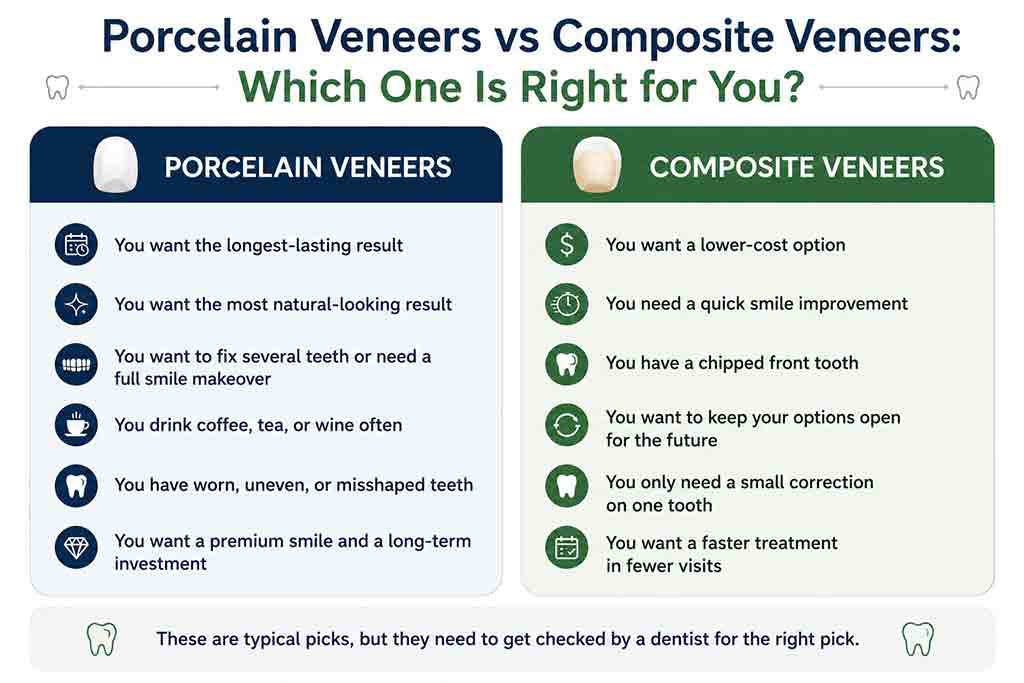
If you grind your teeth at night, ask your dentist about a custom night guard before you commit to either material, since grinding can wear down or crack a veneer faster than normal use. A no-prep option also exists for some cases, so ask whether it fits before you rule veneers out.
Will Your Veneers Look Natural, or Fake?
Porcelain reflects light close to real enamel and resists stains well over the years. Composite has closed much of that gap with newer resin, though it can lose some shine as it wears. Here is the point most guides skip: the natural look depends as much on how well your dentist matches the shade to your face in person as it does on the material itself. A rushed process, or a shade picked without seeing your face, often causes the bulky, overly white look people worry about online. A careful, in-person fit with either material can look like your own teeth, not a swap for them.
Can You Switch Later, or Undo the Choice?
Composite stays reversible in most cases, since your dentist removes little to no enamel to place it. Porcelain does not work the same way. (American Dental Association, MouthHealthy, “Veneers”) Once your dentist removes enamel to fit a porcelain shell, that choice becomes permanent, and you cannot return to your natural tooth surface. If you want to keep your options open, composite gives you that room. If you want a long-term result and the permanence does not bother you, porcelain may suit you better.
Does It Matter If You Need One Tooth Fixed or a Full Smile Makeover?
If you already know how many veneers you need, from one chipped tooth to a full smile makeover, the size of your case changes the answer, though most general guides treat this as one single decision. A single chipped or discolored front tooth often works well with one composite veneer, since it costs less and keeps your options open for a small fix. A full smile makeover across many visible teeth more often leans toward porcelain, since it holds a steady color and lasts longer across a bigger investment. This is a general pattern, not a fixed rule. A real exam with your dentist decides what fits your case.
Talk It Through With an Ahwatukee Dentist
The right pick between porcelain veneers vs composite veneers comes down to your budget, how long you want the result to last, and how many teeth you need to fix. They both fix real problems, and neither one wins in every case.
At Atrium Dental in Ahwatukee, Dr. Shahyar Foroughi, DDS, and Dr. Baharak Foroughi, DDS, both Arizona licensed general dentists, walk patients through this exact choice every week. Our team checks your bite, your smile goals, and your budget before we recommend a material, and we offer both porcelain and composite veneers along with night guards, whitening, and Invisalign to round out a full smile plan.
Call Atrium Dental at (480) 940-4321 to set up a consultation at 4425 E. Agave Rd. #130, Phoenix, AZ 85044, and get a real answer for your own smile.
FAQs
Which is better, composite bonding vs porcelain veneers?
Porcelain lasts longer and resists stains better. Composite costs less and often finishes in one visit. The right choice depends on your goal.
Do I need veneers on every tooth, or just one?
No. A single composite veneer often fixes one chipped or discolored tooth. Porcelain suits a full smile makeover more often.
Are composite veneers worth it?
Yes, if you want a lower cost, a one-visit result, and room to change later. Porcelain fits you better if longevity matters most.
Can you mix porcelain and composite veneers in the same smile?
Yes. Some patients use porcelain on front teeth and composite elsewhere. Plan this with your dentist so the shade matches.
Can veneers be combined with other treatments?
Yes. Patients often pair veneers with whitening or with Invisalign first. Your dentist reviews your full case before a recommendation.
What is the price difference between composite and porcelain veneers?
Composite generally costs less upfront. Ask Atrium Dental to confirm your exact price at a consultation.
Can I get veneers if I grind my teeth?
Grinding can wear down or crack a veneer faster, especially composite. Ask about a custom night guard to protect it.