
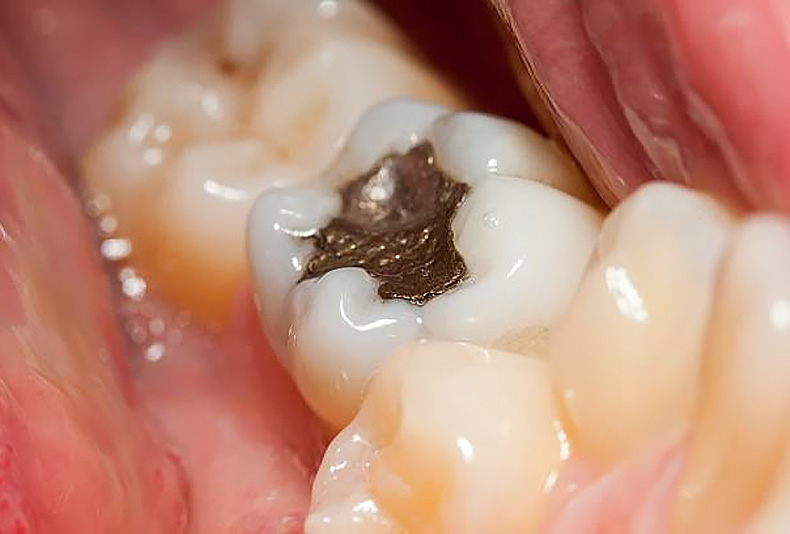
You just left the dentist and found out you need a few fillings. Maybe more than you expected. Now you are sitting there wondering, how many fillings are normal?
There is no fixed number! Most adults have between 3 and 10 fillings over their lifetime. Having a few fillings is common, and what matters most is your age, your history, and whether new decay is caught early
Tooth decay is one of the most common health conditions there is (CDC). What matters is your age, your history, and whether new decay is being caught early.
Table of Contents
ToggleHow Many Cavities Does the Average Person Have?
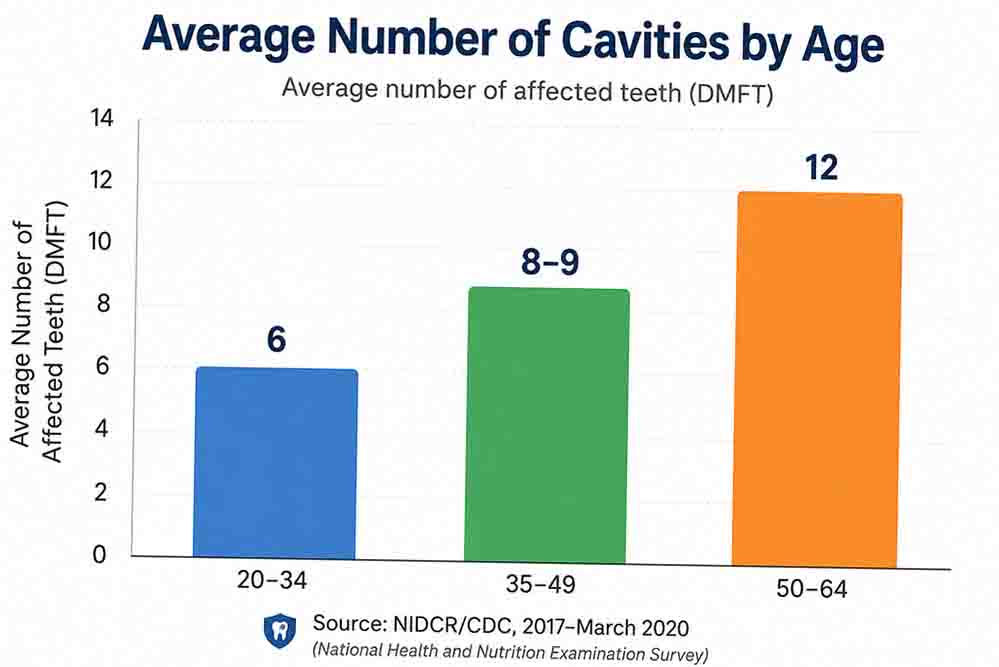
Dentists sometimes track this average number with a score called DMFT (decayed, missing, or filled teeth), but you do not need to know that term to understand your own mouth.
The number of affected teeth rises with age, mainly because more years have passed, not because dental health is getting worse. Recent government data (NIDCR, CDC) shows the average by age group:
Most people get their first dental filling around age 20. After that, your count depends on genetics, diet, and access to dental care.
Average Number of Cavities by Age
How common are fillings? Yes, they are! Very common. Nearly 9 in 10 adults have had at least one cavity, and most of those are treated with a filling. Having one or more fillings over a lifetime is closer to the norm than the exception.
The ranges below are a general guideline for normal cavity counts by age:
Children (Ages 1 to 12)
The normal range is 0 to 3 cavities.
Cavities are common in young children because of sugary snacks, juice, and inconsistent brushing. Tooth decay in baby teeth is often called early childhood caries. By age five, about 1 in 5 children has at least one cavity and needs a filling.
Teenagers (Ages 13 to 19)
The normal range is 1 to 4 cavities.
Teenagers may get cavities from soda, sports drinks, and irregular brushing. Braces can also make teeth harder to clean, which raises the risk. Building good habits during the teen years helps lower the number of cavities later in life.
Adults (Ages 20 to 64)
The normal range is 2 to 7 cavities, trending higher for people in their 50s and 60s, in line with the DMFT numbers above.
More plaque, enamel wear, and gumline cavities from receding gums are common with age. Regular visits, daily flossing, and fluoride toothpaste all help prevent new cavities.
You may also see a narrower range of 0 to 5, with a lifetime average closer to 2 or 3. Counts vary a lot and rise with age, which is why the range here runs wider. More than four or five cavities in your 20s or 30s is worth mentioning to your dentist.
Seniors (65 and Older)
The normal range is 5 to 15 cavities over a lifetime.
Older adults often get cavities on the roots of their teeth. This happens because receding gums expose softer parts of the tooth that are not protected by enamel. Dry mouth caused by medication is another common reason cavities increase in this age group.

How Many Cavities Is Normal in Kids?
There is no single normal number, but here is what the data shows. Kids ages 2 to 5 who have decay average 4.4 affected baby teeth, and by ages 6 to 8 more than half of kids show some decay in baby teeth. Once adult teeth come in, kids ages 6 to 11 who have decay average 2 affected teeth (NIDCR).
This is common and not a sign a parent did something wrong, though it still needs regular pediatric dental checkups. Here’s some information parents would like to know:
- 80% of cavities happen in just 25% of kids. (Adventure Dental)
- 84% of kids’ cavities form in tooth grooves, which is why dentists often recommend sealants. (Adventure Dental)
- Cavity-causing bacteria can spread from parent to child through shared spoons or cups.
- Low saliva flow raises cavity risk, since saliva rinses away food and neutralizes acid. (Adventure Dental)
How Many Cavities Is a Lot?
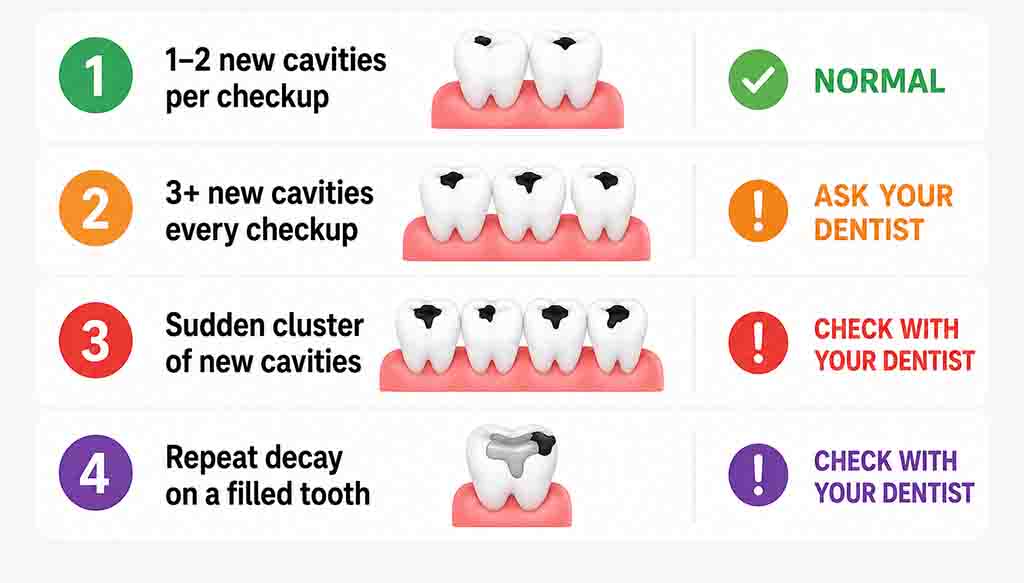
About 90% of adults ages 20 to 64 have had at least one cavity in their life, and about 1 in 5 has at least one cavity that is not yet treated (CDC). Add back the sourcing this claim had in an earlier draft. How often new cavities show up, and whether they get treated, matters more than the total number you have.
What Factors Influence the Number of Fillings You Have?
A few real factors explain the changes in the average cavity per person:
- Dry mouth or medications that lower saliva flow, since saliva normally rinses away food and neutralizes acid
- Frequent sugary or acidic snacks and drinks, which give bacteria more chances to produce acid on your teeth
- Genetics and naturally thinner tooth enamel
- Limited fluoride, which normally helps rebuild weak spots in enamel before they turn into cavities
- Gaps in access to regular dental care
- Deep grooves in the back molars, where plaque and bacteria such as Streptococcus mutans can hide
- Braces or other dental appliances that make brushing harder
- Gum disease, since receding gums expose root surfaces that decay more easily than enamel, which is why some adults suddenly get several new cavities in their 40s, 50s, or 60s
Is It Bad to Have a Lot of Fillings?
No, not automatically. In many cases, several fillings just means decay was caught and treated the right way. Most adults have between 3 and 10 fillings over a lifetime (Dr. Katz), and seniors typically have the most.
Still, a growing number of fillings is worth watching:
- Each filling removes some enamel, so heavily filled teeth are more prone to chip or crack.
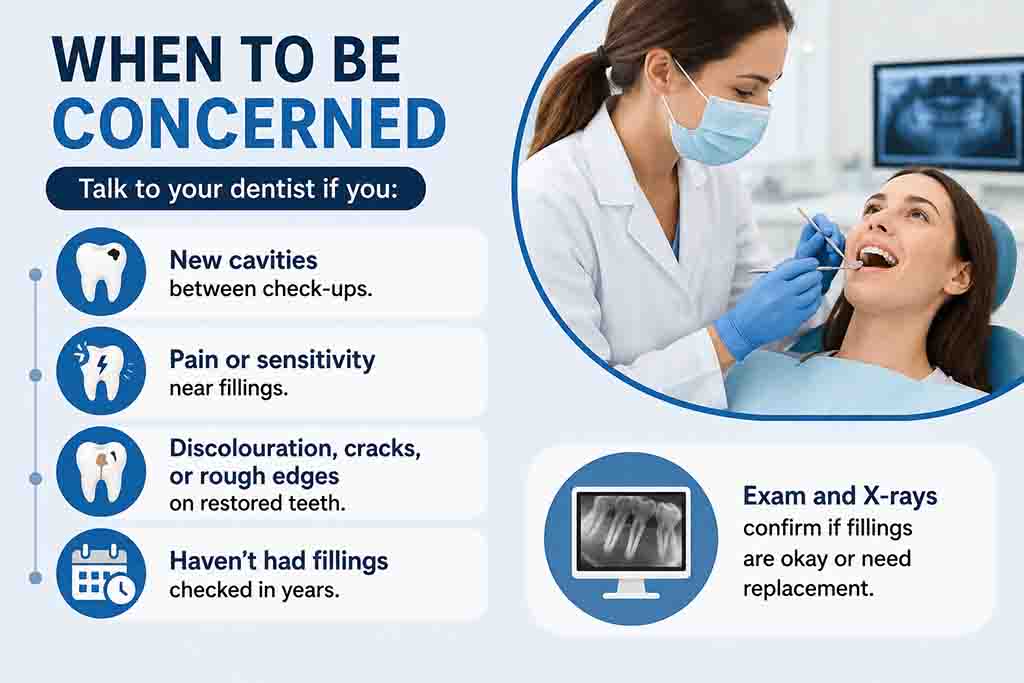
- Fillings wear down over time and can crack, loosen, or leak, letting new decay start underneath.
- Frequent new fillings can point to an unaddressed risk factor like diet, brushing habits, or dry mouth.
Composite fillings last about 5 to 10 years, and amalgam fillings 10 to 15 years or longer, so regular checkups still matter even for teeth that already have a filling. If your dentist notices a pattern of repeat cavities, they can help fix the real cause instead of just treating the same problem again.
How to Reduce and Prevent Future Fillings
Preventing how many cavities you have is the best way to keep your filling count low over time. A few simple habits make a real difference:
- Brush twice a day with fluoride toothpaste.
- Floss once a day to clear plaque from between teeth.
- Cut back on sugary and acidic drinks like soda, juice, and energy drinks.
- Drink water often to rinse away leftover food.
- Keep up with regular cleanings and cavity checks.
- Ask your dentist about fluoride treatments or sealants, especially for children and teens.
These steps will not guarantee you never get another cavity, but they can meaningfully lower your risk over your lifetime.
How Many Fillings are Normal? Let’s Recap
To wrap it up, generally, 0 to 3 cavities is common in childhood, 1 to 4 in the teen years, 2 to 7 in adulthood, and 5 to 15 over a lifetime by the senior years. What matters more than any single number is whether new decay is showing up faster than expected for your age, and whether it is being caught and treated.
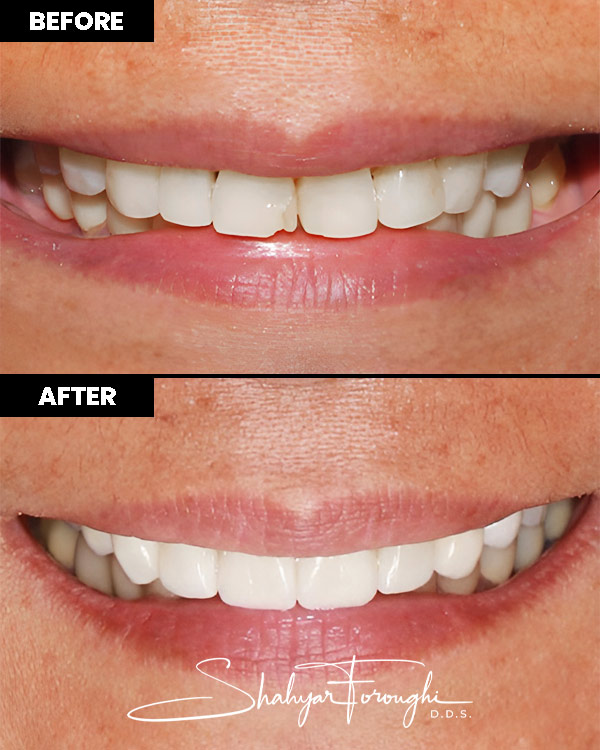
At Atrium Dental, Dr. Shahyar “Sean” Foroughi, D.D.S., an Arizona-licensed dentist practicing since 2000 and Atrium’s owner since 2004, and our team walk patients through exactly this kind of question every day. We take X-rays and explain exactly what they show before recommending any treatment, so you understand what is happening in your mouth and why, not just that you need a filling.
Call Atrium Dental at (480) 940-4321 for a full exam and cleaning, dental fillings in Ahwatukee, or a pediatric checkup, or visit us at 4425 E. Agave Rd. #130, Phoenix, AZ 85044.
FAQs
How many fillings are normal at 20?
A couple to a handful. The average affected tooth count for this age is about 6 (NIDCR).
How many fillings are normal at 25?
A handful or fewer, rising slowly from your early 20s. A sudden jump is what’s worth asking about.
What is the average number of cavities by age 30?
About 6 affected teeth on average (NIDCR), climbing gradually through this decade.
What is the average number of cavities by age 40?
Higher than your 20s and 30s, averaging 8 to 9 affected teeth (NIDCR), from cumulative wear, not worse dental health.
Is 7 fillings a lot?
Not over a lifetime. Seven at one visit is different and worth discussing with your dentist.
How many fillings is too many?
There’s no fixed cutoff, though most adults have 3 to 10 over a lifetime. More than four or five in your 20s or 30s, several new ones at once, or repeat decay on the same tooth are the real signals to flag.
Is it bad to have 12 cavities?
Not on its own, if it built up gradually and is being treated. A sudden jump is what matters more.
Is it normal to have 20 cavities?
Over a full lifetime, yes for some people. A quick jump to that count is worth flagging to a dentist.
Is 3 cavity fillings a lot?
No. Routine for a single visit, mostly a matter of comfort and appointment length.
Why do I suddenly have 10 cavities?
Usually a specific change: less saliva from a new medication, more sugary snacking, or gum disease. Ask your dentist which fits.
Is 5 cavities a lot?
Not over a lifetime, fairly normal by your 30s or 40s. Five at one visit is different.
Is it normal to have 10 or more cavities?
Can be, over a lifetime. Adults in their 50s and 60s average close to 12 (CDC). A high count from one visit matters more.
How many fillings can be done in one visit?
Depends on number, location, and comfort. Multiple in one visit is routine and safe.