
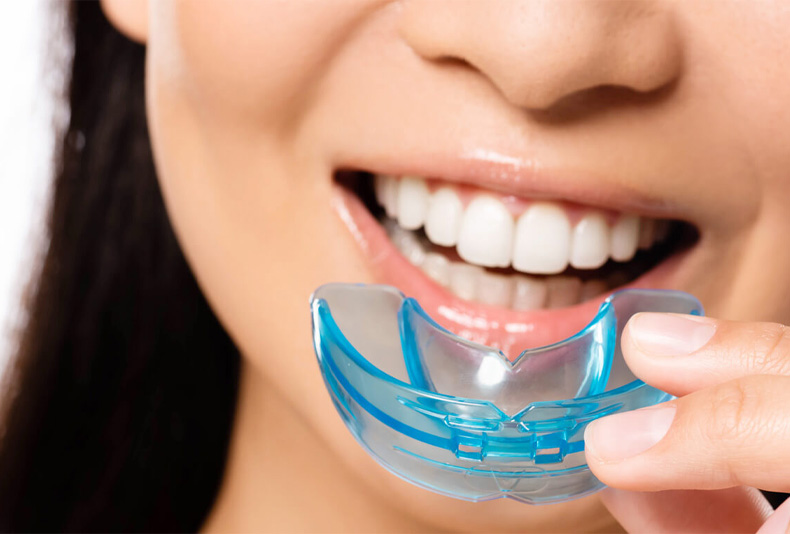
You just got fitted for a night guard, and now you have a work call in an hour. And now you are wondering: Can you talk with a night guard?
Yes, most people can talk with a night guard. Speech usually sounds slightly different for the first few nights, most often a mild lisp on “s” and “th” sounds, and typically returns to normal within one to two weeks.
This article walks through why it happens, how long it really takes to adjust to a night guard for teeth grinding, what you can do about it tonight, and how to tell normal adjustment apart from a guard that simply does not fit.
Table of Contents
ToggleWhy Night Guards Affect Speech
A night guard or bruxism guard changes the way you talk because it takes up space where your tongue normally rests and touches your teeth or palate. Sounds that need precise tongue placement, like “s”, “sh”, “ch”, “th”, and some “t”, “d”, “n”, and “l” sounds, are usually the first ones affected. This is sometimes called a night guard lisp, and it is a normal part of wearing any oral appliance, including occlusal splints used for bruxism and TMJ (occlusal splint review).
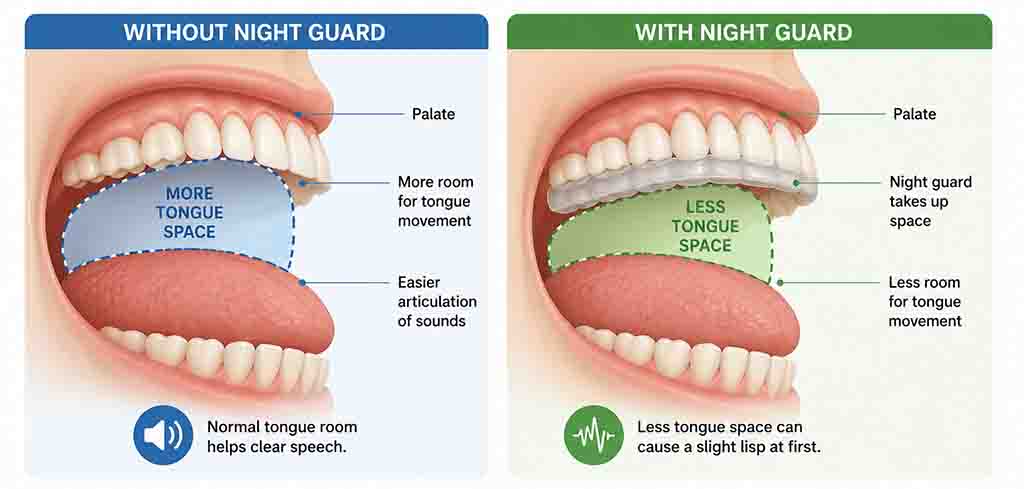
A few things patients commonly notice in the first few nights:
- A mild lisp or trouble pronouncing certain words, especially ones with s and th sounds.
- A bulky or crowded feeling in the mouth.
- The tongue needs to find new placements to make familiar sounds, which feels effortful before it feels automatic.
Common Concerns About Dental Guards and Speech
You can talk with a night guard, but there are the 3 typical concerns that come up most often, and none of them point to a lasting problem:
Will this change how I talk for good? No. A properly fitted night guard is very unlikely to cause a lasting speech impediment. Most people fully adjust within one to two weeks. The tongue and cheeks adapt with regular wear, usually within one to two weeks.
Will people at work or at home notice I sound different? Possibly, for the first few days, especially on words with s or th sounds. Most people find the change is mild and fades quickly, and it is rarely as noticeable to others as it feels to you.
Will I start mispronouncing things that matter, like names or work terms? It can happen at first, particularly with less familiar or longer words. Slowing down slightly and practicing those specific words helps this resolve faster.

Tips to Talk More Clearly with Night Guards
As mentioned, You can talk with a night guard, but you need to get used to them first. These tips help you learn how to get used to a night guard:
- Read a page out loud, narrate a task, or even sing for a few minutes with the guard in, so your mouth learns the appliance under real speaking conditions, not just while falling asleep.
- Wear the guard for short stretches during the day before relying on it all night, so the adjustment happens gradually instead of all at once.
- Speak a little slower and enunciate more deliberately. This reduces slurring while your tongue relearns where to go.
- Keep water nearby. A dry mouth makes any speech change more noticeable, so staying hydrated helps articulation stay smoother.
- Gently guide your tongue tip to the same spot behind your front teeth for s and t sounds. This rebuilds muscle memory faster than talking normally and hoping it improves.
- Try a few tongue twisters, or one read-aloud paragraph a day as a short warm-up for the muscles involved.
- Record a short voice memo every few days. Hearing the playback makes it easier to notice which specific sounds are still affected, so you can practice those instead of guessing.
Does the Type of Night Guard Matter?
Yes. Upper versus lower placement, material thickness, and custom versus store-bought all affect how much a guard interferes with speech.
Upper vs. Lower Night Guard
An upper guard covers the palate, which the tongue uses for “s” and “th” sounds, so it typically affects speech more than a lower guard. It is still very workable once you adjust (occlusal splint review). Your dentist picks upper or lower based on where your grinding happens, not speech.
Soft vs. Hard Night Guard
Thinner, closely contoured guards leave more room for the tongue than bulky ones. Soft materials can feel less obstructive at first but hold their shape less well over time. For speech, thickness and fit matter more than soft versus hard.
Custom vs. Over-the-Counter
A custom guard is molded to your own teeth, so it interferes with speech less than a generic one. Custom guards offer:
- A thinner, more precise design
- Improved comfort through the night
- Less impact on speech
- Better protection, since it stays seated properly
Over-the-counter or boil-and-bite guards feel thicker, fit less precisely, and can shift while you talk, which is usually what makes speech feel more awkward, not the guard itself.
Note: You can talk with a night guard, but if grinding is more than a night guard can address, our guide to full mouth reconstruction for bruxism covers those options.
How Long Does It Take to Get Used to a Night Guard?
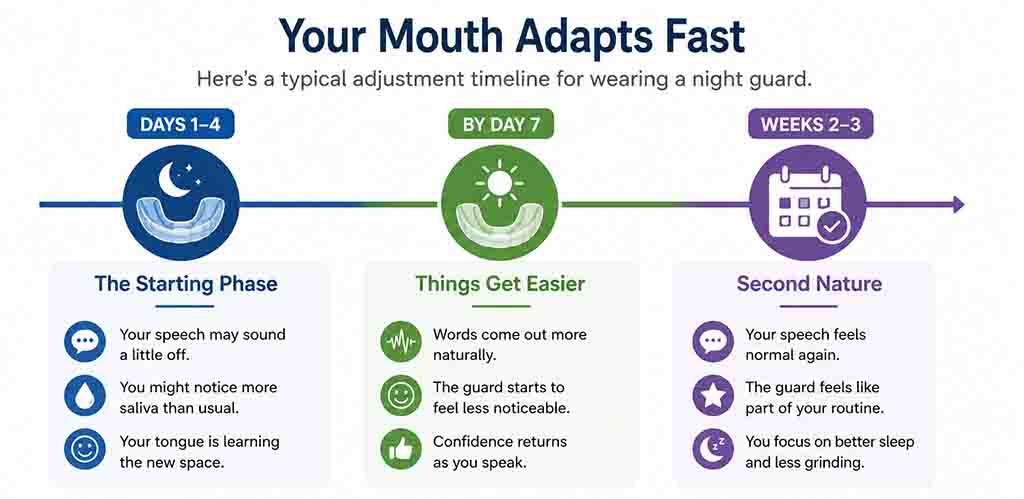
Most people find mouthguard speech adjustment takes about 7 to 14 days. Thinner guards, about 2mm, take 3 to 5 days. Thicker guards, 3 to 4mm, take 7 to 10 days.
- Nights 1 to 4: The most noticeable stretch, with soft lisp-like sounds and extra saliva
- End of week 1: Clear improvement in speech and comfort
- Weeks 2 to 3: Full adjustment, later in this range for thicker or store-bought guards
Comfort follows roughly the same 1 to 2 week timeline as speech. Mild soreness in the first few nights is normal. Wearing the guard for short daytime stretches first, checking that it seats fully, and having your dentist smooth any sharp spots all help it feel comfortable sooner.
A short, practical list to speed up the night guard adjustment period:
- Wear the night guard every night as recommended, rather than skipping nights.
- Read aloud for a few minutes before bed.
- Practice tricky words slowly and clearly.
- Remember that consistent practice, not willpower, is what shortens the timeline.
A well-fitted night guard should not cause lasting speech problems.
Is It Adjustment, or a Fit Problem?
Most speech changes are simple adjustments. But a guard that never gets easier to talk with, or one that feels off in other ways, may be a fit problem instead.
How should a night guard fit? A properly fitted night guard should sit snugly against your teeth without needing you to bite down or clench to hold it in place. It should not rock, shift, or lift on one side, and it should not need constant readjusting with your tongue or fingers through the night. It should feel secure, but not so tight that it causes soreness by morning.
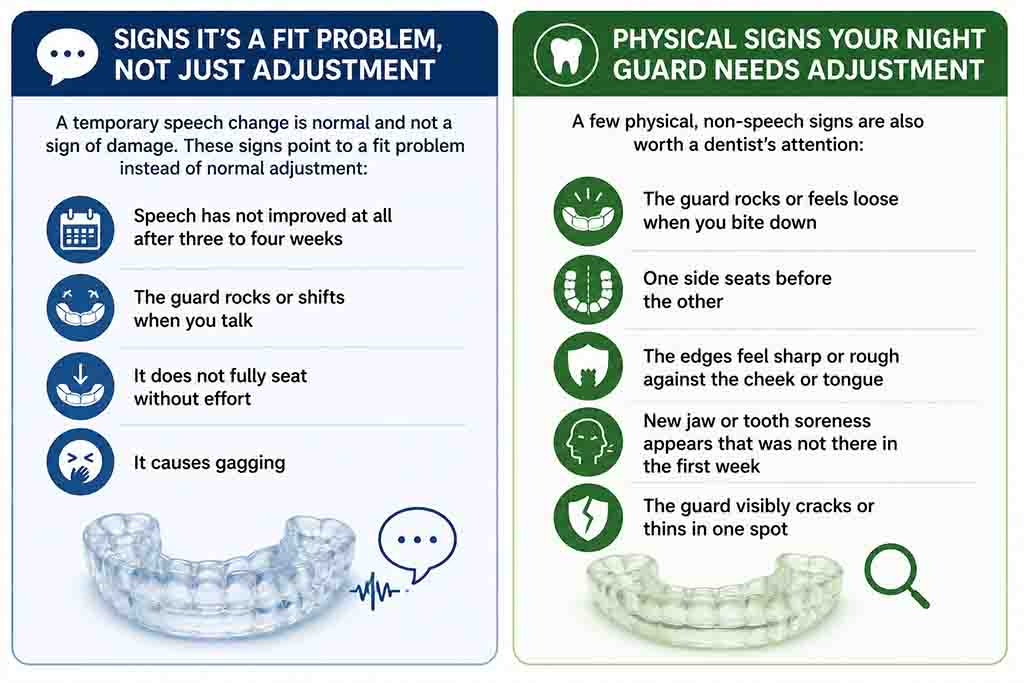
If an over-the-counter guard is behind any of these, a custom fit is usually the fix, since it is built to your own bite instead of a generic shape. A poor fit can also affect more than your speech, so it is worth knowing how a poorly fitted guard can affect your gums.
Custom Night Guards at Atrium Dental
So can you talk with a night guard? Yes. Most people can talk with a night guard, and any change in speech settles within one to two weeks. A guard that has not gotten easier to talk with after three or four weeks, or one that rocks, shifts, or does not seat fully, points to a fit problem worth checking rather than pushing through.
Still having trouble talking with your night guard after a few weeks? It may be time for a fit check. At Atrium Dental, Dr. Shahyar “Sean” Foroughi, D.D.S., an Arizona-licensed dentist practicing since 2000 and Atrium’s owner since 2004, and our team fit custom night guards shaped to your own bite and arch, the single biggest factor in minimizing speech interference compared to a store-bought guard, for patients in Ahwatukee, Phoenix, Tempe, Chandler, and nearby South Mountain.
Call Atrium Dental at (480) 940-4321 to book your full dental exam for a fit check or a custom night guard, or visit us at 4425 E. Agave Rd. #130, Phoenix, AZ 85044.
FAQs
Do dental guards affect speech?
Yes, for most people, for the first 1 to 2 weeks. It is a normal, temporary adjustment, not a sign anything is wrong.
Do night guards cause a lisp permanently?
Not usually, when the guard fits properly. Most lisps from a night guard fade within one to two weeks, and ongoing trouble points to a fit issue rather than a permanent change.
Are there any tricks to improve speech with a dental guard?
Reading aloud before bed, slowing down on s and th sounds, and practicing tongue placement against the roof of the mouth all speed up adjustment.
How long before I speak normally?
Most people improve within a week and speak normally within 1 to 2 weeks of nightly wear. Thinner, well-fitted guards resolve faster.
Is it normal to still have trouble talking after a few weeks?
Some people take longer, especially with a thicker or store-bought guard. No improvement at all after 3 to 4 weeks, or a guard that shifts, is worth having checked.
Should I take my night guard out to talk?
No. Removing it repeatedly slows down adaptation. Wearing it consistently, including during short bursts of talking, helps your tongue adjust faster.
How long does it take to adjust to a night guard?
Most people improve within a week and are fully adjusted, for comfort and speech, within 1 to 2 weeks.
Are night guards hard to get used to?
Not usually. The first few nights are the most noticeable, with some saliva, bulkiness, or minor speech changes, easing quickly from there.